
Why will a masonry heater reduce the fuel you’ve burned in the past? Why will it make your home feel more comfortable? Several variables impact the energy reduction from your secondary heating system after installing a masonry heater. A direct line of sight from the masonry heater to each area of your home is very important.
As a radiant heating device, a masonry heater effectively heats areas within a direct line of sight. However, it heats spaces separated by one or more walls much less effectively. The reasons are very similar to why it is harder to stay warm in most homes during winter. This happens even though the inside air temperature remains at 68 degrees year-round. The following explains this phenomenon. It also shows how radiant masonry heaters can help eliminate this problem while lowering your heating fuel costs.
The term mean radiant temperature (MRT) describes the radiant temperature of a room. In this space, all objects emit and receive sufficient radiation to sustain their heat loss. These objects include walls, floor and ceiling. The human body will reach thermal equilibrium depending on the heat balance of the body and its environment. MRT and air temperature combine to achieve a heat balance and are largely dependent on each person’s metabolic rate.
The Raber-Hutchinson comfort equation theorizes something specific. Ambient air temperature plus the mean radiant temperature (MRT) of surrounding surfaces will equal 140 degrees Fahrenheit. In other words, if the MRT is 70º F, the air temperature must also be 70º F for comfort. For every degree drop in MRT, the room temperature must increase by one degree. This maintains comfort for the people in the room.
This also explains a familiar situation. You can be comfortable in your home in the summer wearing a t-shirt with 68-degree air temperatures. Yet in winter, you can be cold in the same room with 72-degree air temperatures while wearing a sweater. The radiant energy of the sun is stronger in the summer. This raises the MRT for all the solids that make up your home.
Similarly, a masonry heater directly heats the solids, including the people. This increases the MRT in your home. It allows you to be comfortable at lower ambient air temperatures. Convective heating devices do little to raise the temperature of solids in the room. Therefore, the air temperature must be higher to keep inhabitants comfortable. This variable is magnified in poorly insulated and leaky homes. Many such homes were built throughout the United States over the last 50 years.
Many modern homes are designed around a heat loss calculation and a resulting BTU per hour input requirement. Radiant heating systems are normally sized at a lower input capacity than convection heating. This is due to several factors. These include the different mode of heat transfer, higher MRT, and thermal mass. They also include minimal difference between ceiling and floor temperatures. Finally, there is the windchill effect of convective heat.
Our experience and industry-wide testing shows a clear pattern. The BTU per hour requirement for a space with a radiant masonry heater is lower. On average, it will be 20-30% lower than the same space with a convection heating system. However, this applies only to the area of the home within a direct line of sight of the masonry heater. The input capacity for certain areas should not be reduced. This applies to areas not within a direct line of sight of the heater. Furthermore, placement near an exterior wall affects performance. A masonry heater placed there can lose up to 40% of its BTU capacity. This loss occurs on the side of the heater facing the wall. Only a masonry heater placed centrally within a space will achieve the maximum MRT increase and energy input requirement reduction.
The third type of heat transfer is conduction. Many of our clients find a quick way to warm up after being outside on a cold winter day. They take advantage of their masonry heater’s conductive heat transfer. They sit on the heated bench and warm their back against the side wall…
All of this explains why traditional convective heating devices are inherently inefficient. It is impossible to predict a fuel reduction rate for any particular home. This would require a thorough and detailed study of the space, structure, and heating systems. However, our experience with many previous customers shows significant savings. Those replacing wood stoves and forced air systems have seen a 40-75% reduction in secondary heating system fuel consumption.
How does radiant heat support better health? First, it fosters better circulation in the body, which promotes healing. It also encourages better respiration, a stronger immune systems and better metabolisms. We generally have fewer colds or flu in the summer. This is due to increased light and radiation from the sun. Having radiant heat all year long enhances this living environment. Masonry heaters radiate heat instead of circulating air. This results in a significant decrease in allergies and airborne particles. The radiant heat also does not dry out the air. This leads to fewer potential respiratory ailments such as asthma, bronchitis, sinusitis, and nosebleeds. This will also reduce eye and skin irritation.
Radiant heat provides a similar environment to the sun’s rays warming the earth in spring. This promotes a healthier environment in which to live. Conventional wisdom holds that frequent, dramatic temperature changes are hard for the body to adjust to. In Colorado, that’s exactly what we experience and meteorologists refer to our climate as harsh. It is harsh on the people who live here as well as the plants and trees. Delicate vegetation does not survive here on its own.
Convection heaters produce draftiness and uneven temperatures which can leave one feeling decidedly uncomfortable. Temperatures are substantially warmer at the ceiling. Meanwhile, the area near the floor can be quite cool. Our feet can also be quite cool. No wonder we love our warm slippers in the winter! We also run our humidifiers, especially in the fall and winter after we have turned our furnaces on. The furnace dries out the air and circulates last season’s dust and pollens around our homes. The humidifiers not only add moisture to the dry air. The water molecules also tend to attach to dust and allergens. This pulls them to the floor or the furniture!
Just imagine the radiant heater. Its thermal mass keeps slowly giving off its gentle heat. The room is warmed pretty evenly. The floor isn’t dramatically cooler than the ceiling. It doesn’t dry out the air. It doesn’t circulate dust, pollen or anything else throughout the room irritating those with sensitivities.
One beauty of radiant heat is the much greater comfortable temperature range. The radiant heat warms not just the air, but everything in the room! The heater doesn’t burn you if you touch it. The surface temperature is about 150°F to 170°F. However, it may be somewhat higher around the fuel door. If the heater is fired properly, the heat is radiated rather evenly throughout the day and night. Your body doesn’t have to adjust to dramatic changes in warmth or cold throughout the day. There is no need to.
We hope this helps you understand the wonder of radiant warmth and health delivered by a Greenstone Masonry Heater. Please call or email us today to discuss your project.
Discover the benefits of safe, comfortable, allergy reducing wood heat
While convection heaters create draftiness and circulate dust, dirt, and even molds and mildew throughout the heated area, radiant heat provides even temperatures from floor to ceiling. It works on the same principle as the sun does warming the earth on a calm spring day. I am reminded of a conversation I had with a chiropractor about a dozen years ago. I had been in an auto accident and received a whiplash injury from another auto hitting me from behind. This happened in the fall of the year.
During the winter, I told the doctor that I was concerned it was taking so long to heal from the injury. He replied, wait until spring when the sun comes back and you will heal very quickly. I waited rather impatiently until spring came and his advice proved to be right on! Within a few weeks I was substantially improved and my visits to his office dropped dramatically.
Radiant heat provides a similar environment to the sun’s rays warming the earth in spring, promoting a healthier environment in which to live. Conventional wisdom holds that frequent, dramatic temperature changes are hard for the body to adjust to. In Colorado, that’s exactly what we experience and meteorologists refer to our climate as harsh. It is harsh on the people who live here as well as the plants and trees. Delicate vegetation does not survive here on its own.
Convection heaters produce draftiness and uneven temperatures which can leave one feeling decidedly uncomfortable. Temperatures are substantially warmer at the ceiling, while the area near the floor, including our feet, can be quite cool. No wonder we love our warm slippers in the winter! We also run our humidifiers, especially in the fall and winter after we have turned our furnaces on. The furnace dries out the air and circulates last season’s dust and pollens around our homes. Humidifiers not only add moisture to dry air, but the water molecules also tend to attach to dust and allergens, pulling them down to the floor or onto furniture.
Just imagine the radiant heater. Its thermal mass keeps slowly giving off its gentle heat. The room is warmed pretty evenly. The floor isn’t dramatically cooler than the ceiling. It doesn’t dry out the air. It doesn’t circulate dust, pollen or anything else throughout the room irritating those with sensitivities. One beauty of radiant heat is the much greater comfortable temperature range. The radiant heat warms not just the air, but everything in the room!
The heater doesn’t burn you if you touch it. The surface temperature is about 150°F to 170°F. However, it may be somewhat higher around the fuel door. If the heater is fired properly, the heat is radiated rather evenly throughout the day and night. Your body doesn’t have to adjust to dramatic changes in warmth or cold throughout the day. There is no need to.
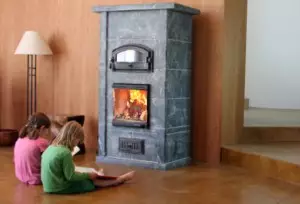 How does radiant heat support better health? First, it fosters better circulation in the body, which promotes healing. It also encourages better respiration, a stronger immune systems and better metabolisms. As we generally have fewer colds or flu in the summer due to the increased light and radiation from the sun, having radiant heat all year long increases this living environment. Because masonry heaters are radiating heat instead of having any form or air circulation or movement there is also a significant decrease in allergies and particles moving in the air. The radiant heat provided also does not dry out the air which results in less potential repertory ailments such as asthma, bronchitis, sinusitis and nosebleeds. This will also reduce eye and skin irritation.Radiant heat provides a similar environment, as the sun’s rays warming the earth in the spring, which promotes a healthier environment in which to live. Conventional wisdom holds that frequent, dramatic temperature changes are hard for the body to adjust to. In Colorado, that’s exactly what we experience and meteorologists refer to our climate as harsh. It is harsh on the people who live here as well as the plants and trees. Delicate vegetation does not survive here on its own. Convection heaters produce draftiness and uneven temperatures which can leave one feeling decidedly uncomfortable. Temperatures are substantially warmer at the ceiling, while the area near the floor can be quite cool, as well as our feet. No wonder we love our warm slippers in the winter! We also run our humidifiers, especially in the fall and winter after we have turned our furnaces on. The furnace dries out the air and circulates last season’s dust and pollens around our homes. The humidifiers not only add moisture to the dry air, the water molecules tend to attach to the dust and allergens to pull them to the floor or the furniture! Masonry Heater Radiant Heat.
Just imagine the radiant heater. Its thermal mass keeps slowly giving off its gentle heat and the room is warmed pretty evenly, so the floor isn’t dramatically cooler than the ceiling. It doesn’t dry out the air. It doesn’t circulate dust, pollen or anything else throughout the room irritating those with sensitivities. One beauty of radiant heat is that you have a much greater temperature range that is comfortable because the radiant heat is not just warming the air, but everything in the room! The heater doesn’t burn you if you touch it because the surface temperature is about 150°F to 170°F, although possibly somewhat higher around the fuel door. If the heater is fired properly, the heat is radiated rather evenly throughout the day and night. Your body doesn’t have to adjust to dramatic changes in warmth or cold throughout the course of a day because there is no need to.
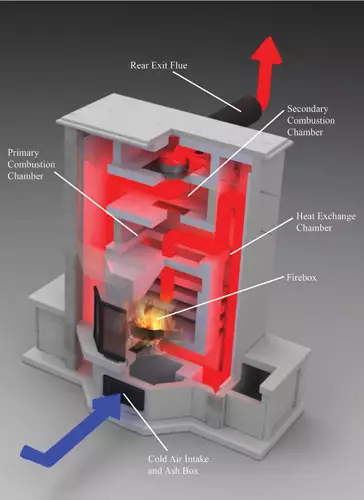 Contra: Against or contrary. Flow: To issue or move in a stream. Circulate. Then, what is a contraflow design? Well, in a masonry heater it is referring to the route the heat takes as it moves through the heater. Simply put, if left to itself, heat tends to rise. In a masonry heater, the heat rises, then goes down through a masonry channel and then rises again to the chimney where it exits the heater. So, think up, down, up again, and in some cases it can also include around. The around portion can occur when a warmed bench is included in the design. The importance of the contraflow design is evident. It allows the entire masonry portion of the heater to warm. In turn, the masonry radiates the heat into the surrounding area in a gentle manner. Radiant heating and the contraflow design does not tend to dry out the air, your nasal passages or your skin, as a convection heater does.
Discover the benefits of safe, comfortable, allergy reducing wood heat
 While convection heaters produce draftiness circulating dust, dirt and even molds and mildew throughout the heated area, radiant heat provides even temperatures from floor to ceiling. It works on the same principle as the sun does warming the earth on a calm spring day. I am reminded of a conversation I had with a chiropractor about a dozen years ago. I had been in an auto accident and received a whiplash injury from another auto hitting me from behind. This happened in the fall of the year. During the winter I commented to the doctor that I was concerned that it was taking so long to heal from the injury. He replied, wait until spring when the sun comes back and you will heal very quickly. I waited rather impatiently until spring came and his advice proved to be right on! Within a few weeks I was substantially improved and my visits to his office dropped dramatically. Radiant heat provides a similar environment, as the sun’s rays warming the earth in the spring, which promotes a healthier environment in which to live. Conventional wisdom holds that frequent, dramatic temperature changes are hard for the body to adjust to. In Colorado, that’s exactly what we experience and meteorologists refer to our climate as harsh. It is harsh on the people who live here as well as the plants and trees. Delicate vegetation does not survive here on its own. Convection heaters produce draftiness and uneven temperatures which can leave one feeling decidedly uncomfortable. Temperatures are substantially warmer at the ceiling, while the area near the floor can be quite cool, as well as our feet. No wonder we love our warm slippers in the winter! We also run our humidifiers, especially in the fall and winter after we have turned our furnaces on. The furnace dries out the air and circulates last season’s dust and pollens around our homes. The humidifiers not only add moisture to the dry air, the water molecules tend to attach to the dust and allergens to pull them to the floor or the furniture!
Just imagine the radiant heater. Its thermal mass keeps slowly giving off its gentle heat and the room is warmed pretty evenly, so the floor isn’t dramatically cooler than the ceiling. It doesn’t dry out the air. It doesn’t circulate dust, pollen or anything else throughout the room irritating those with sensitivities. One beauty of radiant heat is that you have a much greater temperature range that is comfortable because the radiant heat is not just warming the air, but everything in the room! The heater doesn’t burn you if you touch it because the surface temperature is about 150°F to 170°F, although possibly somewhat higher around the fuel door. If the heater is fired properly, the heat is radiated rather evenly throughout the day and night. Your body doesn’t have to adjust to dramatic changes in warmth or cold throughout the course of a day because there is no need to.