

If you heat with wood, you already know the rhythm. Load the stove, watch it burn hot, feel the room warm up, then watch it cool down two hours later. Reload. Repeat. All winter long.
Most wood-burning homeowners accept this as just how wood heat works. It is not.
A soapstone masonry heater operates on an entirely different principle, and the gap in real-world performance between the two systems is significant enough that anyone seriously evaluating wood heat owes it to themselves to understand the difference before making a decision.
This is not a comparison of price tags. It is a comparison of what each system actually does, how it does it, and what living with each one looks and feels like across a full heating season.
Here are eight meaningful benefits where a masonry heater separates itself from a conventional wood stove.
6-12
W/m·K thermal
conductivity
100+
year operational
lifespan
30%
more soapstone vs competitors
50%
longer heat output
per fire
Dramatically Higher Combustion Efficiency
This is the number that explains everything else.
A conventional wood stove achieves combustion efficiency of 60 to 75 percent. EPA-certified models with catalytic technology can push toward 75 to 80 percent on a good day. A soapstone masonry heater routinely achieves 85 to 92 percent, according to the U.S. Department of Energy, which specifically recommends masonry heaters as the most efficient wood-burning heating option available for residential use.
The reason for this gap comes down to combustion temperature. A wood stove manages heat output by restricting airflow, which means the fire burns slowly and incompletely. A masonry heater does the opposite. You build a small, concentrated fire and let it burn fully and intensely, with temperatures in the firebox reaching 1,200 degrees Fahrenheit or higher. At those temperatures, wood gases that would normally escape as smoke are fully combusted in a secondary burn before they ever reach the flue.
The result is that almost no energy escapes unused. The stone captures it. The stone holds it. The stone gives it back to you over the next 18 to 24 hours.
By the numbers: The DOE identifies masonry heaters as producing more heat and less pollution than any other wood or pellet-burning residential appliance. That statement covers every EPA-certified stove, every pellet stove, and every catalytic combustor on the market.
Up to 70 Percent Less Firewood
This benefit is where the investment math becomes impossible to ignore.
A conventional wood stove heating a 2,000 square foot home through a full winter in a cold climate typically burns 6 to 8 cords of wood per season. A masonry heater heating the same home burns 1 to 3 cords. That is a reduction of 60 to 80 percent in wood consumption for equivalent heat output.
At current cord wood prices of $200 to $400 per cord in most regions, that savings translates to $1,000 to $2,800 per heating season, every year, indefinitely. The average Greenstone customer reports investment payback in 5 to 7 years through wood savings alone, after which the heater produces substantial ongoing savings for the rest of its operational life, which is measured in generations, not years.
The efficiency behind this reduction is not magic. It is engineering. When combustion is near-complete and heat exchange is maximized before anything reaches the flue, far less energy is wasted. The firebox burns shorter and hotter, which is thermodynamically far more productive than burning longer and cooler.
For a deeper look at how this works mechanically, see our guide What Is a Masonry Heater? The Ancient Secret Behind the World’s Most Efficient Wood Heat.
One Fire Heats Your Home for 18 to 24 Hours
One of the clearest ways to understand the difference between these two systems is to think about what your evenings look like.
With a wood stove, the heat output is directly tied to the fire. You have warmth when the fire is burning hot, and the room cools when it dies down. A full day of heating requires multiple fire cycles, frequent loading, and constant monitoring. Many wood stove owners find themselves getting up in the night to reload.
With a masonry heater, you light one focused fire, typically burning for two to four hours in the evening. The firebox reaches extreme temperatures and the stone mass absorbs that energy completely. By the time the fire is out, the stone holds enough stored heat to radiate consistent warmth throughout the following day.
Wake up in the morning and the home is still warm. Not fading-warmth warm. Genuinely comfortable. The heater is still slowly releasing what it stored the night before.
This changes the experience of heating with wood entirely. Instead of a job you manage all day, it becomes a single task in your evening routine.
Radiant Heat That Feels Fundamentally Different
This is the benefit that is hardest to quantify but most frequently cited by homeowners who have made the switch.
A wood stove heats primarily by convection, warming the air near the stove and relying on that warm air circulating through the room. The result is temperature stratification, hot near the stove and ceiling, cooler at floor level and in distant corners. When the fire dies, the air cools quickly.
A masonry heater heats by radiation, the same mechanism by which the sun warms you on a cool day. Radiant heat transfers directly to solid objects and people without needing warm air as the medium. The stone surface, which reaches 140 to 180 degrees Fahrenheit, emits long-wave infrared radiation that warms the floors, walls, furniture, and occupants of the room evenly and directly.
The subjective result is that a home heated by radiant mass feels warmer and more comfortable at a lower air temperature than a home heated by convection. Occupants consistently describe it as feeling like the house itself is warm, rather than the air inside it.
There is also no blower, no fan, and no mechanical system cycling on and off. The warmth is quiet, even, and continuous.
For a more detailed explanation of radiant versus convection heat, visit our page Radiant vs. Convection Heat.
Near-Zero Emissions and EPA Exemption
The EPA’s residential wood heater regulations require certified wood stoves to meet a smoke emission standard of 2.0 grams per hour as of 2020. That standard was specifically developed to address the significant particulate pollution produced by incomplete, low-temperature combustion in conventional stoves.
Masonry heaters are exempt from this regulatory framework entirely. The EPA explicitly excluded masonry heaters from the NSPS certification requirements because their near-complete, high-temperature combustion produces emissions so low they fell outside the category the regulations were designed to address. Research data on masonry heater particulate emissions typically shows outputs well below those of the cleanest certified wood stoves on the market.
For homeowners who care about air quality, whether for environmental reasons, health reasons, or proximity to neighbors, this distinction matters. A masonry heater running correctly produces a clean, nearly invisible exhaust. A wood stove smoldering at low temperatures produces the visible, particulate-heavy smoke that wood-burning regulations were written to reduce.
The environmental case is reinforced by the dramatically lower wood consumption. Using 70 percent less wood to produce the same heat means 70 percent fewer emissions, even before accounting for the superior combustion quality.

Built-In Cooking Capability
This is a benefit that conventional wood stoves simply cannot replicate at the same level.
Greenstone masonry heaters are available with integrated bake ovens built directly into the thermal mass of the heater. Because the surrounding stone moderates temperature so precisely, these ovens deliver the kind of steady, even heat that produces exceptional results:
- Artisan bread with the open crumb and thick crust that only a stone oven produces
- Slow roasts and braises that hold temperature without drying out
- Wood-fired pizza at temperatures comparable to dedicated commercial ovens
- Casseroles and baked dishes that benefit from sustained, surrounding heat
A cooktop surface is also available on select models, adding a functional cooking dimension directly above the firebox area.
Because masonry heaters require no electricity to operate, these cooking capabilities remain fully functional during power outages. For homeowners in areas where winter storms regularly knock out power, that is not a feature. It is a genuine contingency.
Explore Greenstone’s bake oven options across the Valencia, Dorchester, and custom design series.
Safer for Families, Children, and Pets
The surface temperature of a conventional wood stove during operation can reach 400 to 600 degrees Fahrenheit or higher. At those temperatures, accidental contact causes immediate, severe burns. This is a genuine and serious risk for households with young children or pets.
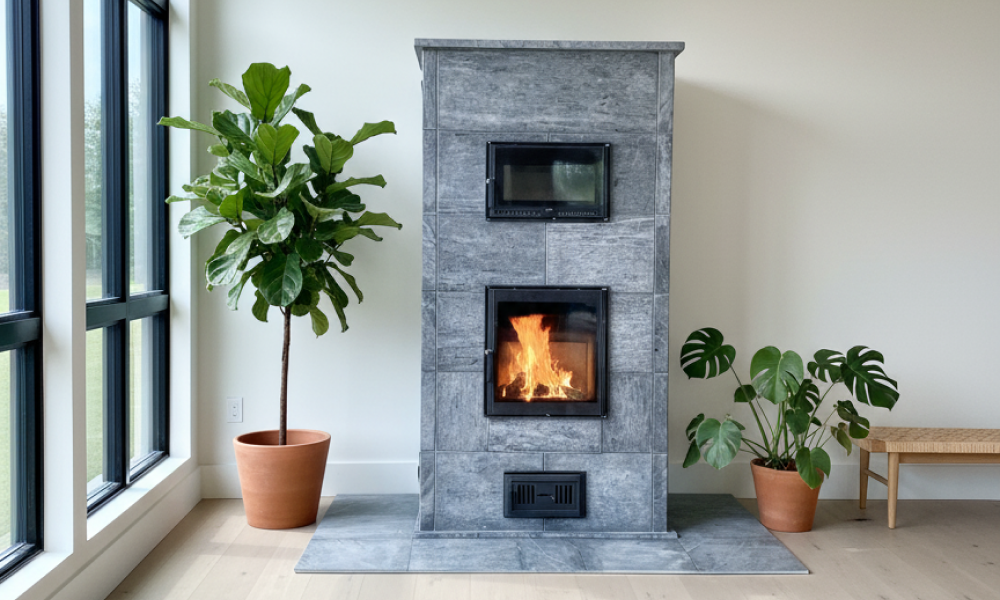
A masonry heater operates differently. Because the heat is stored in thousands of pounds of stone and released slowly, the exterior surface reaches only 140 to 180 degrees Fahrenheit. That range is warm to the touch and deeply comfortable against skin, but it will not cause burns on incidental contact.
This is one of the reasons that European homes, where masonry heaters have been common for centuries, are designed with them as accessible, central features of the living space rather than objects that must be cordoned off. The heater can be in the middle of a room that children and pets use freely.
For families making a long-term heating choice, the difference in surface safety between these two systems is not a minor consideration.
A Custom-Designed Architectural Centerpiece
A conventional wood stove is an appliance. It is practical, it functions, and it occupies a corner or a hearth. Very few homeowners would describe their wood stove as the defining element of a room.
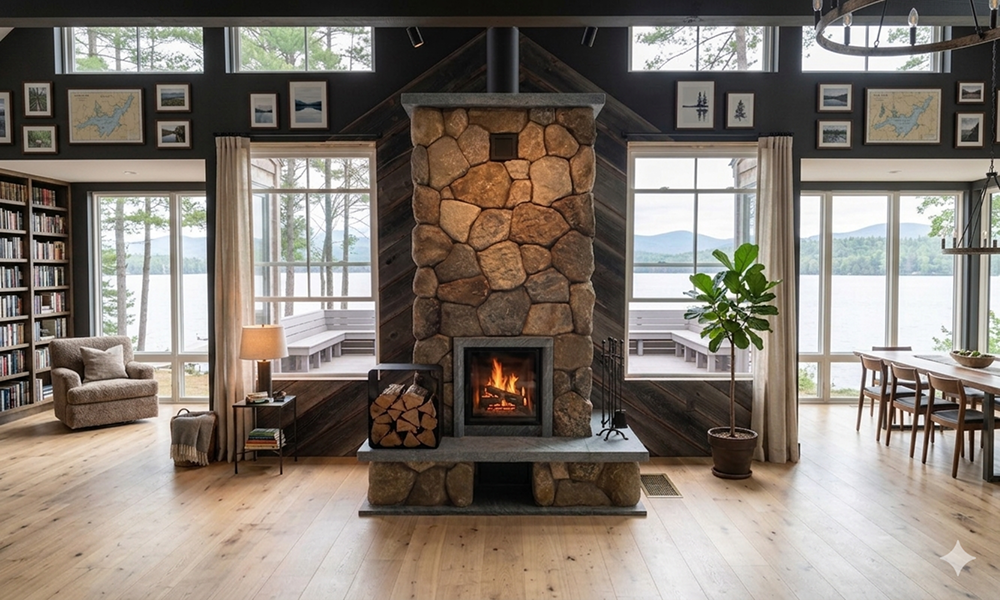
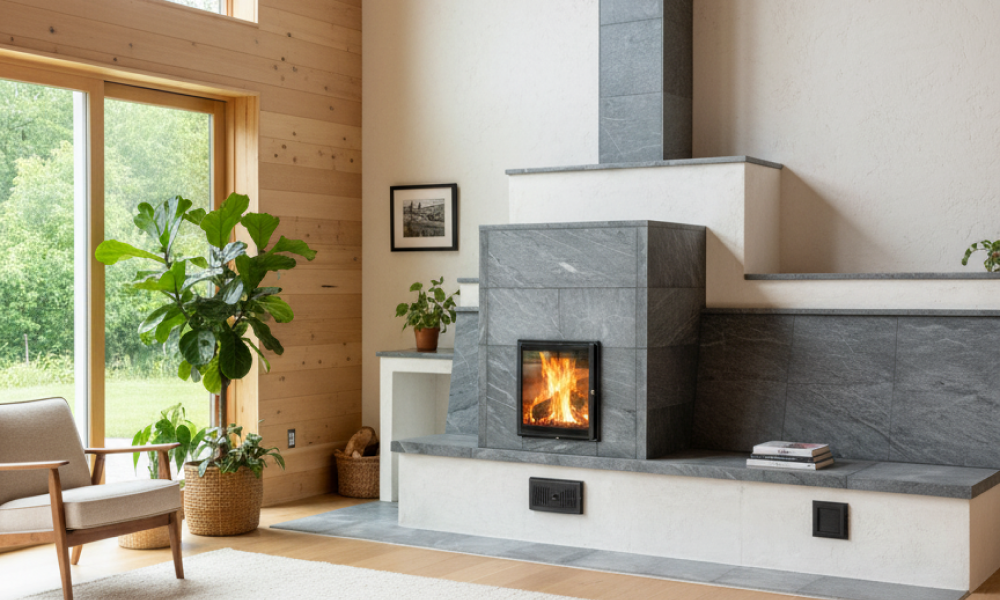
A Greenstone soapstone masonry heater is something else entirely. It is a custom-designed, hand-crafted stone structure that anchors a room architecturally and visually. Homeowners and architects who commission one begin with the heater and design the room around it.
The design options available from Greenstone reflect this reality. Every heater is built to specification, with choices that include:
- Soapstone in multiple finishes from honed to brushed
- Ledgestone, fieldstone, and dry-stack masonry veneers
- Brick and smooth stucco exteriors for contemporary interiors
- Custom heights, proportions, and configurations for corner, wall, or room-divider placement
- Integrated bench seating, mantels, and custom detailing
The Cameron series, for instance, features a double-sided tunnel firebox, functioning as both a room divider and a heater that warms two spaces simultaneously. The Ricota is designed for corner installations. Every series can be built from five to eight courses in height, and every design can incorporate a bake oven, cooktop, or custom stonework.
The result is a heater that looks nothing like a heater in the conventional sense. It looks like exactly what it is: a significant object of craft and material quality, built to be at the center of a home for generations.
Browse completed installations in the Greenstone Gallery, including the Valencia, Dorchester, Ricota, and Cameron series, and the full range of custom designs.
Side-by-Side Comparison at a Glance
For a clear look at how these two systems line up across the metrics that matter most to serious wood-heat buyers:
| Factor | Masonry Heater | Wood Stove |
|---|---|---|
| Combustion efficiency | 85 to 92% | 60 to 75% |
| Wood use per season | 1 to 3 cords | 6 to 8 cords |
| Heat output duration | 18 to 24 hours per fire | 2 to 4 hours per fire |
| Surface temperature | 140 to 180 F (safe to touch) | 400 to 600 F (burn risk) |
| EPA regulation | Exempt (near-zero emissions) | Regulated (2.0 g/h limit) |
| Fires needed per day | 1 to 2 | 4 to 6 |
| Investment payback | 5 to 7 years | N/A (ongoing wood costs) |
The One Honest Tradeoff
A complete comparison requires acknowledging where a masonry heater falls short relative to a wood stove.
A masonry heater cannot respond quickly to a cold start. If the heater has gone cold, it takes time to warm the stone mass back to operating temperature before meaningful radiant heat begins. A wood stove, by contrast, begins warming the room within minutes of lighting.
For homeowners who heat continuously through the winter, this is rarely relevant. The heater stays warm, and one daily fire maintains the cycle. For occasional-use or seasonal heating where the heater may sit cold for extended periods, this is a genuine limitation worth understanding before making a decision.
A Greenstone consultant can help you assess whether your heating pattern and home are well-suited to masonry heater operation.
Who Should Seriously Consider a Masonry Heater?
The homeowners who get the most from a Greenstone masonry heater tend to share a few characteristics:
- Wood heat is their primary heating strategy, not supplemental warmth or ambiance
- They are building or undertaking a significant renovation where the heater can be planned from the foundation up
- They want the heater to be a permanent feature of the home and are investing accordingly
- They value design and craft and want a heating system that reflects those values visually as well as functionally
- They are prepared for a long-term investment with a 5 to 7 year payback horizon and a multi-generational functional lifespan
If that describes you, a soapstone masonry heater is not simply a better wood stove. It is a different category of heating entirely.
Ready to Move Beyond the Wood Stove?
Greenstone is the only American-made soapstone masonry heater designed and built for the custom, high-performance market. If you are ready to have a direct conversation about your home, your heating goals, and what a Greenstone heater would look like at the center of it, the team is ready to talk.
Begin Your Custom Design Consultation
If you are serious about wood heat and ready to invest in a heater that performs at the highest level, Greenstone is the only American-made soapstone masonry heater built for the custom, high-performance market. Every project begins with a direct conversation about your home, your goals, and what you want at the center of it.
Custom consultation | Nationwide installation | Soapstone built to last a lifetime
Call us to start your consultation
Call toll-free: 855-826-9246