

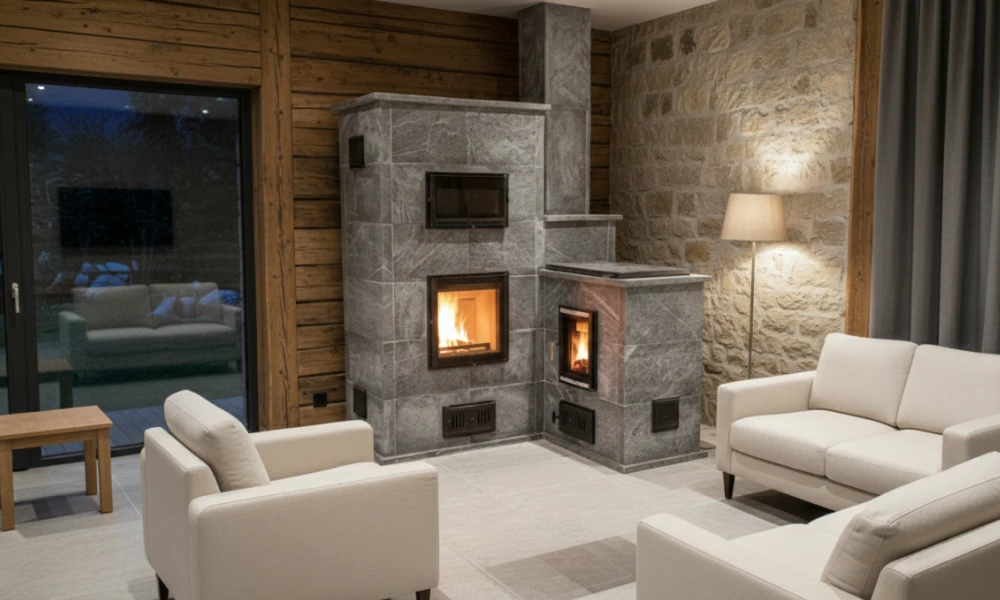
You have done your research. You know the difference between a wood stove and a fireplace insert. You have probably looked at European imports, read about soapstone, and spent more than a few evenings going down rabbit holes about radiant heat. And somewhere along the way, you came across the term masonry heater.
Now you want to understand it properly. Not the surface-level summary, but the real story: how it works, why it performs so dramatically better than anything else available, and whether it belongs at the center of your home.
This guide is written for exactly that person.
A masonry heater is not a wood stove with thicker walls. It is not a decorative fireplace that happens to burn wood. It is a precisely engineered thermodynamic system that has been refined over a thousand years, built from one of the most heat-friendly natural materials on earth, and designed to do one thing exceptionally well: take a single, short, intensely hot fire and turn it into 18 to 24 hours of deep, even, radiant warmth.
When done right, it is also one of the most beautiful objects you can put in a home. A Greenstone masonry heater is both a high-performance heating system and a custom-designed architectural centerpiece. That combination is rare. This guide will explain why it matters.
A Thousand Years of Getting It Right
The masonry heater has roots stretching back over a millennium across Northern and Eastern Europe, where surviving brutal winters without consuming an entire forest was a matter of survival, not preference.
By the 15th and 16th centuries, masonry heaters had become central to everyday life across Finland, Russia, Sweden, Germany, and Austria. The Finnish tulikivi (literally fire stone) and the German kachelofen (tile stove) became cultural icons, passed down through generations alongside the homes they heated. Families planned their floor plans around them. Architects designed rooms to face them.
The insight at the heart of all of these designs was simple and brilliant: do not let the heat escape. Burn your fire fast and hot, capture that energy in stone, and let the stone release it slowly and steadily for the rest of the day. Physics does the work. You simply light the fire.
North America largely bypassed this technology during industrialization, when cheap fossil fuels made efficiency seem like a secondary concern. That calculation has changed. As energy costs climb, sustainable building practices mature, and a new generation of design-forward homeowners demands more from every element of their homes, the masonry heater is earning the prominence it has held in Europe for centuries.
What a Masonry Heater Actually Is
A masonry heater is a wood-burning heating appliance constructed from stone, brick, or ceramic, built around the principle of thermal mass. It stores the energy from a fast, complete fire inside its stone body and releases that energy slowly as radiant warmth over many hours.
Here is what makes it fundamentally different from everything else on the market.
A conventional wood stove burns slowly and continuously, sending heat into the room in real time. A significant portion of that heat escapes up the flue while the fire smolders. You get warmth when the fire is burning. When it dies down, the room cools. You reload and repeat.
A masonry heater works on an entirely different logic. You build a small, intense fire that burns completely in two to four hours. Temperatures inside the firebox reach and exceed 1,800 degrees Fahrenheit. At those temperatures, combustion is nearly total. Wood gases that would normally escape as smoke or particulates are fully burned. The result is maximum energy extracted from minimum wood.
Those hot combustion gases do not go straight up the chimney. Instead, they travel through a carefully engineered internal labyrinth of heat exchange channels, surrendering their heat to the surrounding stone before finally exiting the flue. By the time the gases leave the chimney, they have cooled to 200 to 300 degrees Fahrenheit, compared to 600 to 900 degrees for a typical wood stove. Almost nothing is wasted.
The stone mass surrounding those channels, which can weigh 1,500 to 5,000 pounds depending on the design, absorbs all of that stored energy. It then radiates gentle, consistent warmth into the living space for the next 18 to 24 hours.
One fire. One day of heat. No reloading.
The analogy that makes it click:
A conventional fireplace is like leaving a faucet running. A masonry heater is like filling a tank. The tank holds what you put in, and releases it on your schedule, not the fire’s.
The Engineering Inside the Stone
Understanding how a masonry heater works at the component level makes the efficiency numbers far less surprising.
The Firebox
The firebox is intentionally compact. A small, well-insulated firebox concentrates combustion, driving temperatures high enough to achieve secondary combustion, where the gases produced by burning wood are themselves burned before they escape. This is why masonry heaters are exempt from EPA wood-burning regulations in many jurisdictions. The emissions from a complete, high-temperature burn are so low they fall outside the category the regulations were designed to address.
The Contra-Flow Heat Exchange Channels
After leaving the firebox, hot gases travel through a series of internal baffles and channels, sometimes called the contra-flow system, that force them through a long, winding path before reaching the flue. This path is designed so the gases must give up as much heat as possible to the stone before they are allowed to exit. The result is flue gas temperatures that are a fraction of those produced by conventional wood stoves.
The Soapstone Thermal Core
The stone surrounding those channels stores the captured heat. Soapstone, the material Greenstone uses exclusively, is uniquely suited to this role. It has an unusually high heat capacity relative to its weight, superior thermal conductivity compared to brick or ceramic, and thermal stability that allows it to withstand extreme temperature cycling without cracking or degrading over time. It absorbs heat quickly during the fire and releases it slowly and evenly for hours afterward.
Radiant Output
The surface of a fully charged masonry heater reaches between 140 and 180 degrees Fahrenheit. This is warm and comforting against the skin, but not hot enough to cause burns, which makes it inherently safer than a conventional wood stove surface that can exceed 600 degrees. More importantly, radiant heat warms solid objects and people directly, the way sunlight does, rather than heating air as an intermediary. Occupants consistently report that a home heated by radiant mass feels warmer and more comfortable at lower air temperatures than a home heated by forced air.
How It Compares: An Honest Side-by-Side
For anyone who has spent time researching wood heat, the performance gap between a masonry heater and conventional options is significant enough to warrant a clear comparison.
Traditional Open Fireplace
- Combustion efficiency: Often operates at negative efficiency, drawing conditioned air up the flue
- Wood consumption: Extremely high, with near-continuous feeding required
- Emissions: High particulate output from incomplete, low-temperature combustion
- Heat distribution: Intense heat near the firebox, cold floors and perimeter
- Surface temperature: Can exceed 1,000 degrees at the firebox opening
Conventional Wood Stove
- Combustion efficiency: 60 to 75 percent, with significant heat loss through the flue
- Wood consumption: High, requiring reloading every two to four hours
- Emissions: Moderate to high, particularly during smoldering phases
- Heat distribution: Uneven, dependent on the fire’s current state
- Surface temperature: 400 to 600 degrees, a burn risk for children and pets
Soapstone Masonry Heater
- Combustion efficiency: 85 to 92 percent, the highest of any residential wood-burning system
- Wood consumption: 70 to 80 percent less than stoves or fireplaces for equivalent heat output
- Emissions: Extremely low, EPA-exempt due to complete high-temperature combustion
- Heat distribution: Even, gentle radiant warmth throughout the space for 18 to 24 hours
- Surface temperature: 140 to 180 degrees, safe for incidental contact
The efficiency numbers are striking on their own. But experienced masonry heater owners consistently say the thing they did not expect was the quality of the warmth. Radiant heat does not dry out the air. It does not create the hot-cold cycling of a stove that needs constant attention. It feels, as most describe it, like the home itself is warm rather than the air inside it.
Why Soapstone and Why It Matters
The choice of stone is not cosmetic. It determines how much heat the heater can store, how quickly it absorbs energy from the fire, and how steadily it releases warmth over time. Soapstone outperforms other common heater materials on every thermal measure that matters.
- Higher specific heat capacity: Soapstone stores more energy per pound than brick, granite, or ceramic tile
- Superior thermal conductivity: It absorbs and releases heat faster and more evenly than competing materials
- Thermal cycling stability: Unlike brick, which can develop micro-fractures over years of expansion and contraction, soapstone handles extreme temperature swings without degrading
- Non-porous surface: It does not absorb moisture, odors, or combustion byproducts
- Aesthetic versatility: Its natural texture and depth make it one of the few building materials that improves in appearance with age
Greenstone sources its soapstone from premium quarries in Brazil and India, regions recognized for producing the highest-grade heat-retaining stone available anywhere in the world. Their heaters incorporate 30 percent more soapstone mass than competing designs, which translates directly into 50 percent longer heat output per fire.
That is not a marketing claim. It is simple physics: more thermal mass stores more energy and releases it over a longer period.
Custom Design: The Heater as Architectural Centerpiece
The homeowners and architects who commission a Greenstone masonry heater are not looking for a heating appliance to tuck into a corner. They are designing a room around it.
A masonry heater of this caliber occupies a space in the home the way a great piece of architecture does. It is structural, functional, and visually commanding all at once. Greenstone’s design process reflects that reality. Every heater is a collaboration between the client’s vision, the architect’s specifications, and Greenstone’s masonry engineering expertise.
The four core heater series, Valencia, Dorchester, Ricota, and Cameron, serve as starting points. From there, the customization options are extensive.
Form and Configuration
- Single-sided, double-sided, or corner configurations
- Integrated bench seating that also serves as a warm surface for cold mornings
- Two-sided designs like the Cameron that function as room dividers between living spaces
- Custom heights and proportions tailored to ceiling height and room volume
Exterior Veneers
- Natural soapstone in a range of finishes from honed to brushed
- Ledgestone, fieldstone, and dry-stack masonry for a more rustic character
- Brick for a traditional or industrial aesthetic
- Smooth stucco for contemporary and minimalist interiors
- Custom combinations combining multiple materials within a single design
Functional Additions
- Integrated bake ovens that reach 400 to 500 degrees and hold temperature for hours
- Cooktop surfaces built directly into the heater’s thermal mass
- Custom mantels in stone, timber, or steel
- Decorative tile inlays and hand-carved stone detailing
The result is a heater that looks nothing like a heater in the conventional sense. It looks like exactly what it is: a custom-designed object of significant craft and material quality, built to anchor a room and outlast the home it warms.
Performance That Goes Beyond Heating
One of the more unexpected discoveries for first-time masonry heater owners is that the heater’s usefulness does not stop at warmth.
The integrated bake oven, available on most Greenstone models, is a serious cooking appliance. Because the thermal mass surrounding the oven moderates temperature so precisely, it produces the kind of even, consistent heat that bakers specifically seek out. The results speak clearly:
- Artisan breads with the open crumb and thick crust that only come from a true stone oven
- Slow-roasted meats and braised dishes that hold temperature without drying out
- Wood-fired pizza at temperatures that rival dedicated commercial pizza ovens
- Casseroles, gratins, and baked dishes that benefit from the steady, enveloping heat
The cooktop surface, where available, adds a functional dimension that most heating appliances cannot offer. And because masonry heaters require no electricity to operate, they continue heating and cooking through power outages. In climates where winter storms are a real consideration, that independence has practical value beyond its appeal as a design feature.
The Environmental Logic of a Masonry Heater
Wood heating is sometimes discussed as though it were environmentally equivalent to burning fossil fuels. For a masonry heater, that comparison does not hold.
Wood is a carbon-neutral fuel when sourced from sustainably managed forests. The carbon released during combustion is the same carbon the tree absorbed from the atmosphere during its lifetime. It is a closed cycle. Fossil fuels release carbon that has been sequestered underground for millions of years, carbon that was never part of the current atmospheric cycle.
The masonry heater’s near-complete combustion at high temperatures means that almost no unburned carbon or particulates escape. Emissions are low enough that many jurisdictions have explicitly exempted masonry heaters from EPA wood-burning regulations. The combination of carbon-neutral fuel and near-complete combustion puts a soapstone masonry heater in a genuinely different category from other wood-burning systems.
For homeowners building to net-zero or passive house standards, or designing off-grid properties where energy independence is the goal, a Greenstone masonry heater is a natural fit. It produces no emissions during standby, requires no electricity, and operates entirely on a locally sourced renewable fuel.
Who Commissions a Greenstone Masonry Heater?
It is worth being direct about this. A Greenstone soapstone masonry heater is a significant investment, typically in the range of twenty thousand dollars and above depending on the design, size, and specification. It is not the right solution for every heating need, and Greenstone does not position it as such.
The homeowners and design professionals who work with Greenstone share a few defining characteristics.
They are serious about wood heat as a primary heating strategy
They are not adding a wood-burning appliance for ambiance. They want their home to be genuinely and primarily heated by wood, with the efficiency and performance to make that practical over the long term.
They are investing in the quality and permanence of their home
A Greenstone masonry heater is designed to last indefinitely. European masonry heaters routinely reach 100 years and beyond. For homeowners building or renovating with a long horizon, the investment calculus is straightforward. A heater that lasts a century and reduces annual wood use by 70 to 80 percent pays for itself and continues delivering value long after.
They want the heater to be a design statement
For many Greenstone clients, the heater is the room. The design process begins with the heater and the rest of the space is organized around it. Architects, interior designers, and custom homebuilders who work at the top of the market understand this dynamic and increasingly specify masonry heaters as a starting point in the design process, not an afterthought.
They value expertise and nationwide support
Greenstone is the only American-made soapstone masonry heater on the market with full nationwide sales and installation coverage. Every installation is carried out by Greenstone-trained craftsmen who understand the structural, thermodynamic, and aesthetic requirements of building at this level. That continuity of expertise, from design through installation, is something European imports simply cannot offer on the same terms.
Names You May Have Encountered: A Quick Reference
One source of confusion for buyers researching this category is encountering multiple names for what is fundamentally the same technology. Here is a brief decoder for the most common terms.
- Russian fireplace or Russian stove: A contra-flow masonry heater design with deep roots in Eastern European tradition
- Finnish stove or Tulikivi: The Finnish tradition of soapstone masonry heating, named after Finland’s most recognized manufacturer
- Kachelofen: The German and Austrian ceramic tile stove, a close relative of the soapstone masonry heater
- Thermal mass heater: A generic engineering term describing any heater that stores and slowly releases energy through mass
- Contra-flow stove: An engineering description of the internal gas flow path that distinguishes masonry heaters from conventional designs
These are not identical products, but they share the same defining principle: a thermal mass that captures heat from a fast, efficient fire and releases it slowly over many hours. The soapstone masonry heater represents the most refined, highest-performing evolution of this tradition.
Frequently Asked Questions
How often do I need to fire a masonry heater?
Most owners fire their heater once or twice per day depending on outdoor temperatures and home size. In mild weather, a single evening fire typically keeps the home comfortable well into the following afternoon. During the coldest periods of winter, a morning and evening fire covers most needs completely.
Can a masonry heater serve as my primary heat source?
Yes, and for many Greenstone clients it does exactly that. A properly sized heater can serve as the sole heat source for homes up to approximately 2,500 to 3,000 square feet. For larger homes or properties with complex layouts, a Greenstone consultant will assess your specific situation and recommend a configuration that meets your heating goals.
Is a masonry heater safe for families with children and pets?
It is substantially safer than a conventional wood stove. The exterior surface of a masonry heater reaches 140 to 180 degrees Fahrenheit, warm and pleasant to the touch but not hot enough to cause burns. A conventional wood stove surface can reach 600 degrees or more, posing a genuine burn risk. This difference is meaningful to families and is one of the reasons many parents specifically seek out masonry heaters.
What wood should I burn?
Properly seasoned hardwood with a moisture content below 20 percent is the correct fuel. Oak, maple, ash, and birch all perform well. Dry wood burns hotter and more completely, which is what produces the high-temperature combustion that makes a masonry heater operate at its best. Green or wet wood undermines combustion quality and reduces heat output.
How long does a masonry heater last?
Indefinitely, with appropriate care. European masonry heaters regularly reach 100 years and more. The stone components do not degrade the way mechanical systems do. The inner firebox liner, which takes the most direct thermal stress, is replaceable and extends the heater’s functional life further. When you commission a Greenstone heater, you are building something for generations, not years.
What does the installation process involve?
Greenstone heaters arrive pre-fabricated to your specifications. On-site installation typically takes three to four days. Greenstone coordinates directly with your architect, builder, or engineering team on foundation requirements, flue placement, and any site-specific considerations. The process is professional and planned, not disruptive.
Can an existing fireplace be converted into a masonry heater?
Possibly, depending on the construction of your existing fireplace. Greenstone evaluates conversions individually. Free-standing masonry fireplaces not built into combustible framing are often suitable candidates. Contact Greenstone directly for an assessment of your specific situation.
What is the investment range for a Greenstone heater?
Greenstone’s custom soapstone masonry heaters typically begin at twenty thousand dollars and increase from there based on size, configuration, veneer selection, and added features such as integrated bake ovens or cooktops. For the homeowners Greenstone works with, the payback through dramatically reduced wood consumption and the permanent value added to the property makes the investment straightforward to justify over the life of the home.
The Honest Summary
A masonry heater is not a trend, and it is not a novelty. It is a thousand years of accumulated understanding about how to extract maximum warmth from minimum wood, refined into one of the most intelligent and beautiful heating systems ever built.
For the homeowner who wants to heat primarily with wood, who is building or renovating with a long view, and who understands that the fireplace at the center of a home should be worth centering a home around, there is nothing in the market that performs or looks like a Greenstone soapstone masonry heater.
The efficiency is real. The warmth is unlike anything else. And the object itself, custom-designed, built from premium soapstone, installed by craftsmen who have done this work at the highest level, belongs in a different category from every other wood-burning product available in North America.
Begin Your Custom Design Consultation
Greenstone creates custom soapstone masonry heaters with a personalized design consultation.