

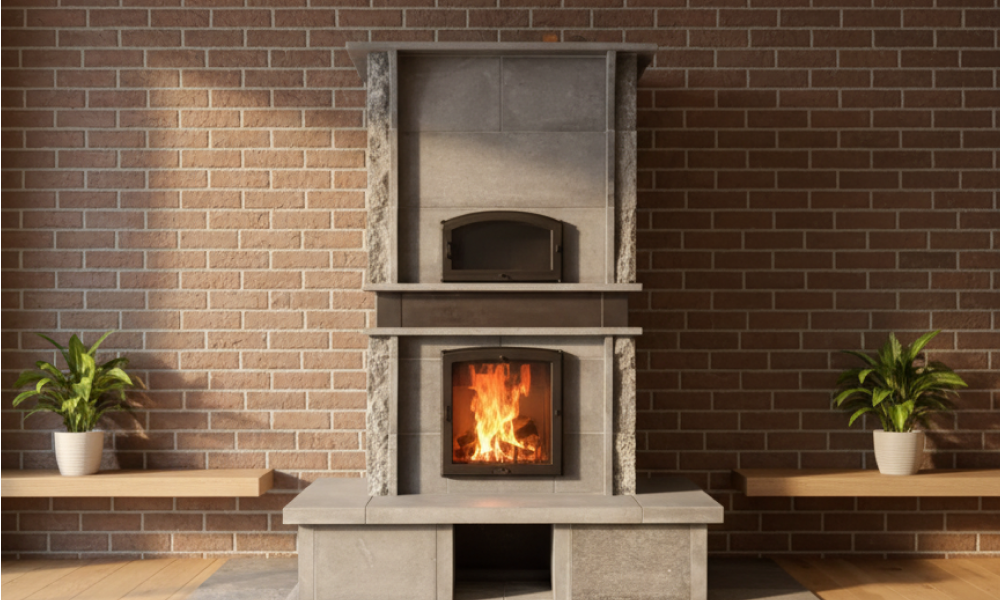
There is a reason the finest masonry heaters built in Finland, Scandinavia, and now North America are made from soapstone rather than brick, ceramic, or cast refractory concrete. It is not tradition for tradition’s sake. It is not aesthetics, though soapstone is genuinely beautiful. It is physics.
Every material that goes into a masonry heater is put under a specific kind of stress. It must absorb enormous heat very quickly, hold it without degrading, and release it slowly and evenly over many hours. It must do this thousands of times over the life of the heater, expanding and contracting with each fire cycle, without cracking, spalling, or losing its structural integrity.
Most materials fail one or more of those tests over time. Soapstone passes all of them, and it does so better than anything else available. This guide explains exactly why, in terms that are useful to a homeowner making a serious purchasing decision, not just a materials scientist reading a datasheet.
85-92%
Combustion efficiency
70%
Less wood burned
24 hrs
Heat from one fire
5-7 yrs
Investment payback
What Soapstone Actually Is
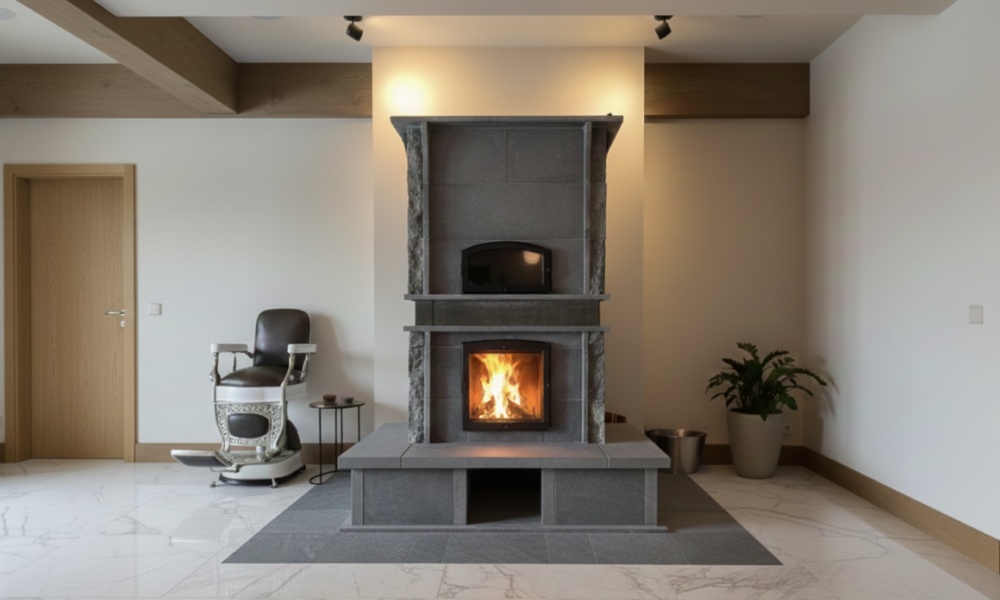
Soapstone is a naturally occurring metamorphic rock composed primarily of talc, along with varying amounts of magnesium silicate, chlorite, and other minerals. It forms under high heat and pressure deep in the earth, which is part of what gives it the thermal properties that make it so well suited to radiant heating applications.
The name comes from its characteristic feel. The high talc content gives soapstone a smooth, slightly slick surface that is unlike any other stone. That same talc content is also responsible for several of its most important thermal properties: its ability to absorb heat quickly, distribute it evenly, and release it slowly as infrared radiation.
Soapstone has been used for heating and cooking applications for thousands of years. The Finnish tradition of the tulikivi, literally fire stone, is named for soapstone specifically. Finnish and Scandinavian craftsmen did not choose soapstone by accident. They chose it because it worked better than anything else available, and that remains true today.
Thermal Conductivity: Why the Numbers Matter in Plain Language
Thermal conductivity measures how quickly a material moves heat from one side to the other. For a masonry heater, this determines how fast the stone absorbs energy from the fire and how evenly it distributes that heat across its surface.
Soapstone has a thermal conductivity of 6 to 12 W/m·K, depending on its mineral composition. That range is five to fifteen times higher than firebrick (0.8 to 1.2 W/m·K) and substantially higher than cast refractory concrete (0.5 to 2.0 W/m·K).
What does that mean in practical terms?
It means that when you build a fire in a soapstone heater, the stone begins absorbing heat from the fire rapidly and distributing it throughout the heater’s mass much faster than a brick or concrete alternative would. The heat does not sit at the surface nearest the firebox. It moves into the stone, through the stone, and across the full mass of the heater, making the entire structure a working thermal battery rather than just the sections immediately adjacent to the heat source.
The result is more even surface temperatures, more consistent radiant output, and a heater that charges fully from a shorter, hotter fire rather than requiring extended burn times to fully warm the mass.
To put this in perspective: A firebrick wall and a soapstone wall of identical dimensions, exposed to the same fire for the same duration, will absorb significantly different amounts of energy. The soapstone wall absorbs more, distributes it more evenly, and retains it more effectively. That difference accumulates over every fire, every season, for the life of the heater.
Heat Storage Capacity: The Thermal Battery Advantage
If thermal conductivity explains how quickly soapstone absorbs heat, specific heat capacity and density together explain how much it can store.
Soapstone’s specific heat capacity is approximately 0.98 to 1.0 kJ/kg·K, combined with a density of 2.8 to 3.0 g/cm³. Together, these numbers mean that a given volume of soapstone stores significantly more thermal energy than the same volume of firebrick or cast refractory.
This is the property that makes a soapstone masonry heater capable of heating a home for 18 to 24 hours from a single two to four hour fire. The stone absorbs so much energy during the burn, and holds it so effectively, that it continues releasing useful warmth long after the fire is out and the ash has cooled.
Greenstone’s heaters are designed with 30 percent more soapstone mass than competing heater designs. This is not a cosmetic difference. It is a direct engineering decision that translates into 50 percent longer heat output per fire, meaning more hours of warmth from the same wood burned.
Related reading: What Is a Masonry Heater? The Ancient Secret Behind the World’s Most Efficient Wood Heat
Thermal Shock Resistance: Built to Last a Lifetime
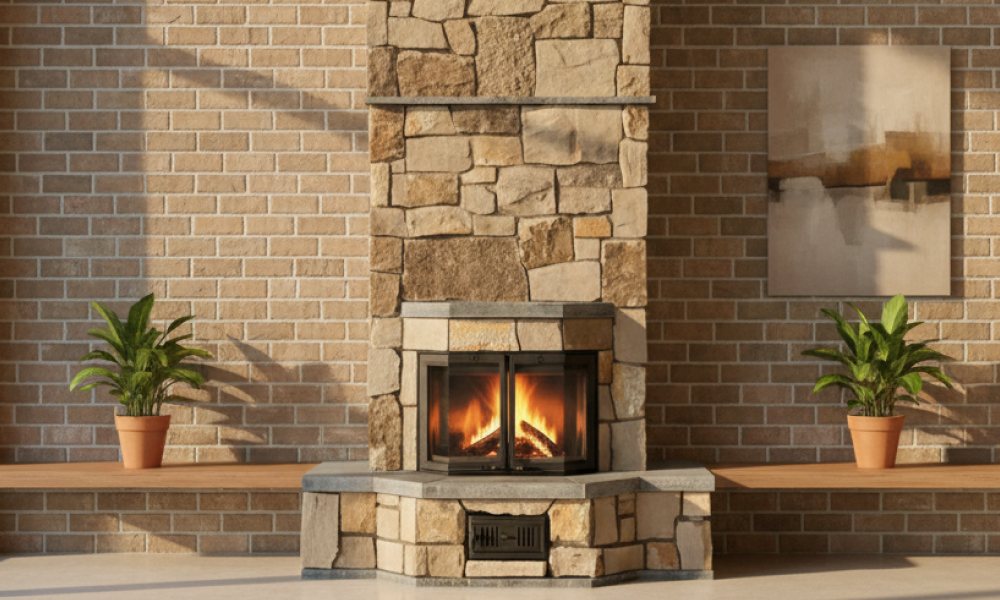
Every masonry heater experiences extreme thermal cycling. From ambient temperature when cold to internal firebox temperatures exceeding 1,200 degrees Fahrenheit when firing, and back again. This cycle repeats daily throughout the heating season, for decades.
The internal stress this creates is significant. Materials that cannot tolerate repeated expansion and contraction develop micro-fractures over time. Those fractures grow. Eventually the material spalls, cracks visibly, or loses its structural integrity.
Soapstone handles thermal cycling exceptionally well. Its low thermal expansion coefficient and the natural flexibility imparted by its talc content allow it to expand and contract without accumulating the internal stress that cracks harder, more brittle materials. Properly installed soapstone heaters do not develop surface cracks from thermal cycling.
Firebrick, by contrast, is a denser and more rigid material. It performs adequately in lower-cycling industrial applications but is measurably more prone to cracking and spalling in the daily heating and cooling cycles of a residential masonry heater. Cast refractory concrete, which is mixed and poured rather than naturally formed, contains inherent inconsistencies from its casting process that create stress concentration points over time.
The long-term implication of this difference is significant. European soapstone masonry heaters routinely reach 100 years and beyond in active service. Brick and refractory heaters require more frequent repair and component replacement.
What this means for your investment: A Greenstone soapstone masonry heater is not a heating appliance on a replacement cycle. It is a permanent architectural element of your home, built to outlast every other system in the structure.
Radiant Heat Emission: The Comfort Difference You Feel
This is the property that is hardest to capture in a specification sheet, but most immediately obvious to anyone who has stood in a room heated by a soapstone masonry heater.
Radiant heat transfer occurs when a warm surface emits infrared radiation that is absorbed directly by people, furniture, floors, and walls in the room, without needing warm air as the medium. The quality of this radiant emission depends on both the surface temperature of the heater and the material’s ability to emit infrared radiation efficiently.
Soapstone emits infrared radiation at wavelengths that are particularly well matched to human thermal comfort. The surface of a charged soapstone heater, which reaches 140 to 180 degrees Fahrenheit, radiates heat in a way that feels like mild sunlight: warm, even, and all-encompassing rather than directional and intense.
Brick and cast refractory surfaces radiate heat less efficiently. They tend to create more localized warmth near the heater rather than the even distribution that characterizes a well-designed soapstone heater. They also retain heat in a way that is less well-suited to steady radiant release, meaning more of the stored energy stays locked in the material rather than warming the room.
The practical result: homeowners with soapstone masonry heaters consistently report that their homes feel warmer and more comfortable at the same air temperature compared to homes heated by forced air or conventional wood stoves. The warmth is not in the air. It is in the room itself.
Related reading: Radiant vs. Convection Heat: Why Your Body Feels the Difference
A Non-Porous Surface That Stays Clean and Beautiful
Soapstone is naturally non-porous. Unlike brick or cast refractory, it does not absorb moisture, combustion byproducts, or odors through its surface. This has several practical implications for a heating appliance that will be in the center of your home for the next century.
- The surface does not stain from moisture or ambient humidity
- Combustion residue cannot penetrate the stone and accumulate over time
- Cleaning the exterior surface requires nothing more than an occasional wipe
- The stone does not develop the musty odor that porous materials can produce when exposed to moisture and then heated
From a design standpoint, soapstone also improves with age in a way that no manufactured or composite material does. Its surface develops a natural patina over time that deepens its color and character. Owners of older soapstone heaters consistently note that the stone looks better after ten years than it did when new.
This matters to the homeowners who commission Greenstone heaters, where the heater is not an appliance tucked into a corner but a central architectural feature designed to be looked at as much as felt.
How Soapstone Compares: A Property-by-Property Breakdown
The table below places soapstone alongside the two most common alternative materials used in masonry heater construction across the key properties that determine long-term heating performance.
| Property | Soapstone | Firebrick | Cast Refractory |
|---|---|---|---|
| Thermal conductivity | 6-12 W/m·K | 0.8-1.2 W/m·K | 0.5-2.0 W/m·K |
| Specific heat capacity | 0.98-1.0 kJ/kg·K | 0.84 kJ/kg·K | 0.8-1.0 kJ/kg·K |
| Density | 2.8-3.0 g/cm³ | 1.9-2.1 g/cm³ | 2.0-2.5 g/cm³ |
| Thermal shock resistance | Excellent | Moderate | Moderate to Low |
| Radiant emission quality | Superior | Average | Below average |
| Crack resistance over time | Excellent | Fair | Fair to Poor |
| Surface feel | Smooth, non-porous | Rough, porous | Rough, porous |
| Lifespan in a heater | 100+ years | 20-40 years | 15-30 years |
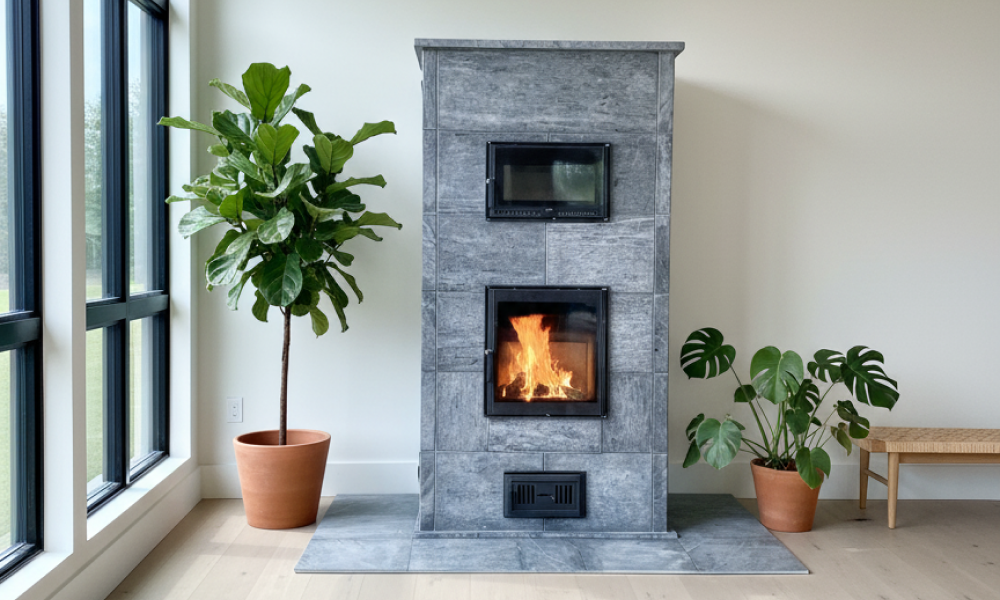
Greenstone’s Soapstone: Why the Source Matters
Not all soapstone is equal. The mineral composition of soapstone varies by quarry and region, and those variations translate directly into differences in thermal conductivity, heat storage capacity, and long-term durability.
Greenstone sources its soapstone exclusively from premium quarries in Brazil and India, two regions recognized globally for producing the highest-grade heat-retaining soapstone available anywhere in the world. The stone is selected specifically for the thermal properties that matter most in a masonry heater context: high conductivity, high specific heat, consistent density, and proven thermal cycling performance.
Every Greenstone heater is built with 30 percent more soapstone mass than competing heater designs. This additional mass is not decorative. It directly extends heat output duration, smooths radiant temperature curves, and increases the total energy storage capacity of the heater. The result is a measurably different heating experience: warmer mornings, longer lasting comfort, and fewer fires needed throughout the day.
Greenstone is also the only American-made soapstone masonry heater on the market, with nationwide sales and installation coverage by Greenstone-trained craftsmen. European soapstone heaters, while excellent in their own right, carry significantly longer lead times and cannot offer the same level of design collaboration, site-specific engineering, and installation continuity that Greenstone provides.
Explore Greenstone’s soapstone data: Soapstone Data and Technical Specifications
Soapstone as a Design Material: Function Meets Craft
The thermal properties of soapstone are the reason it belongs in a masonry heater. The aesthetic properties of soapstone are the reason the best heaters in the world are built from it.
Soapstone’s naturally smooth, matte surface has a depth and warmth that no manufactured material replicates. It can be finished in multiple ways depending on the design intent:
- Honed finish: A smooth, flat surface with a soft, matte appearance. Clean and contemporary.
- Brushed finish: Light surface texture that catches light and shadow. Works well with more organic, natural interior styles.
- Rough split face: The natural fractured surface of the stone, used for a more rustic or architectural expression.
Soapstone is also available in a range of natural colors from light grey to deep charcoal, with subtle green and blue mineral veining in certain quarry grades. These natural variations mean that no two Greenstone heaters are identical. The stone itself makes each one unique.
For homeowners and architects designing around a Greenstone heater, the soapstone exterior is typically combined with one of several veneer options: ledgestone, fieldstone, dry-stack masonry, brick, or smooth stucco. The result is a heater that can be designed to anchor virtually any interior aesthetic, from a contemporary open-plan kitchen to a traditional mountain lodge to a minimalist Scandinavian interior.
Browse completed designs: Greenstone Gallery: Veneer Stone and Brick Options
Frequently Asked Questions
Is soapstone better than firebrick for a masonry heater?
Yes, across every property that determines heating performance. Soapstone has higher thermal conductivity, higher heat storage capacity, better thermal shock resistance, and superior radiant emission characteristics. Firebrick is appropriate for the inner firebox liner, where its refractory properties are needed, but as the primary thermal mass material for the outer heater body, soapstone outperforms firebrick significantly.
What makes soapstone non-porous and why does that matter?
Soapstone’s mineral structure, primarily talc with magnesium silicate, leaves virtually no pore space for moisture or combustion byproducts to penetrate. This matters for a heating appliance because porous materials absorb ambient moisture when cool and release it as steam when heated. Over many cycles this degrades the material and can produce odors. Soapstone’s non-porous surface remains stable, clean, and odor-free throughout the life of the heater.
How long does soapstone last in a masonry heater?
Properly installed soapstone components in a masonry heater last indefinitely under normal residential use. European soapstone heaters built in the 19th century remain in active service today. The thermal cycling stresses that degrade brick and refractory materials over time are handled by soapstone’s low thermal expansion coefficient and natural material flexibility without accumulating structural damage.
Where does Greenstone source its soapstone?
Greenstone sources soapstone from premium quarries in Brazil and India, two of the world’s leading regions for high-grade heat-retaining soapstone. The stone is selected specifically for the thermal conductivity, density, and long-term cycling performance required in a high-performance masonry heater application.
Can soapstone crack from the heat of a masonry heater?
Under normal operating conditions, no. Soapstone’s low thermal expansion coefficient and the natural flexibility imparted by its talc content allow it to handle repeated heating and cooling cycles without cracking. Cracking in soapstone heaters, when it occurs, is typically the result of installation errors, improper expansion allowances, or structural movement in the building rather than the material’s thermal limitations.
Is soapstone safe to touch on the exterior of a heater?
Yes. The exterior surface of a soapstone masonry heater reaches 140 to 180 degrees Fahrenheit during operation. That temperature range is warm and comfortable against skin but does not cause burns on incidental contact. This is dramatically safer than the surface of a conventional wood stove, which can exceed 600 degrees Fahrenheit and causes immediate burns on contact.
Does soapstone look better over time?
Yes, and this is one of the more unusual properties of the material. Soapstone develops a natural patina over years of use that deepens its color and surface character. Owners of older Greenstone heaters consistently note that the stone’s appearance improves with age in a way that manufactured and composite materials never do.
The Bottom Line
When you understand what a masonry heater is actually doing, the case for soapstone becomes obvious. The heater must absorb enormous energy quickly, hold it completely, release it evenly over many hours, and do all of this thousands of times without degrading. No other natural material available in a masonry heater context meets all four of those requirements as well as soapstone does.
It absorbs heat faster than brick or refractory. It stores more of it. It releases it more evenly and at wavelengths better matched to human comfort. It handles the thermal stress of daily cycling without cracking. Its surface stays clean and beautiful for the life of the heater, which is measured in generations.
This is why the world’s best masonry heaters are built from soapstone. And it is why Greenstone builds every heater with more soapstone mass than any competing design on the market.
Ready to Put Soapstone at the Center of Your Home?
Greenstone works with homeowners, architects, and custom builders across North America to design and install soapstone masonry heaters built to the highest standard in the market. Every project begins with a direct conversation about your home, your vision, and what you want at the center of it.
Begin Your Custom Design Consultation
Greenstone is the only American-made soapstone masonry heater built for the custom, high-performance market. If you are serious about wood heat and ready to put the finest radiant heating material at the center of your home, the conversation starts here.
Custom design consultation | Premium soapstone | Nationwide installation
Visit greenstoneheat.com to start your consultation
Call toll-free: 855-826-9246