

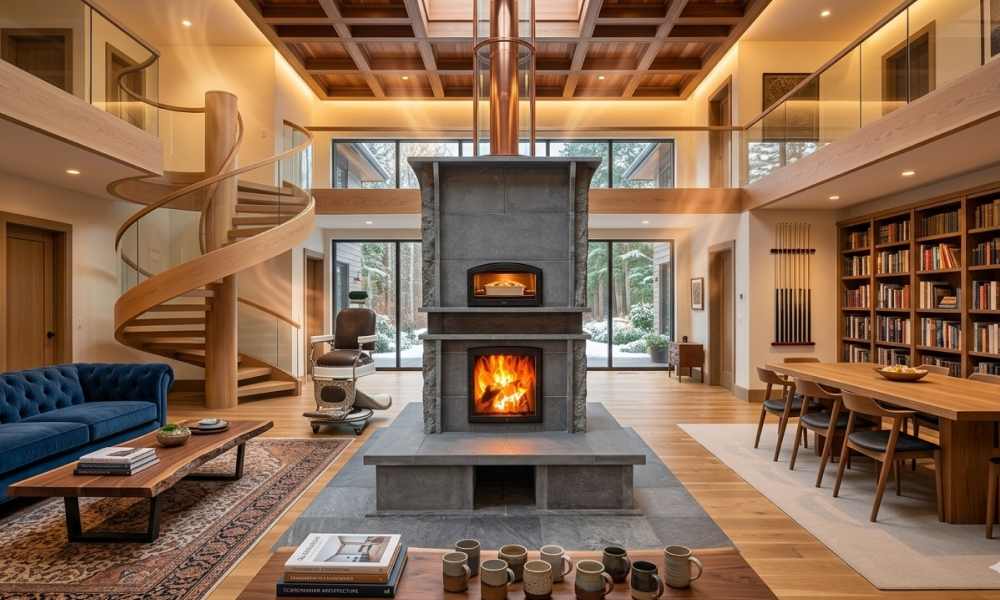
It is the question almost every serious buyer asks early in the process. And it deserves a straight answer rather than a hedge.
Yes. A properly sized soapstone masonry heater can serve as the sole heat source for most North American homes. Hundreds of Greenstone customers heat their homes this way today, using one or two fires per day to keep their homes consistently warm throughout the coldest months of the year.
But the full answer has more detail in it than a simple yes, and understanding that detail is what allows you to make a confident decision rather than a hopeful one.
This guide covers everything that determines whether a masonry heater can heat your whole house: the physics behind it, the factors that matter most, how to think about sizing, the floor plan and insulation variables that affect real-world performance, and the specific situations where a masonry heater works best as a sole source versus where a supplemental strategy makes more sense.
By the end, you will have a clear framework for evaluating your own home, not a vague answer that leaves you guessing.
3,000
sq ft heated by one heater
85-92%
combustion efficiency
24 hrs
heat from a single fire
70%
longer heat output
per fire
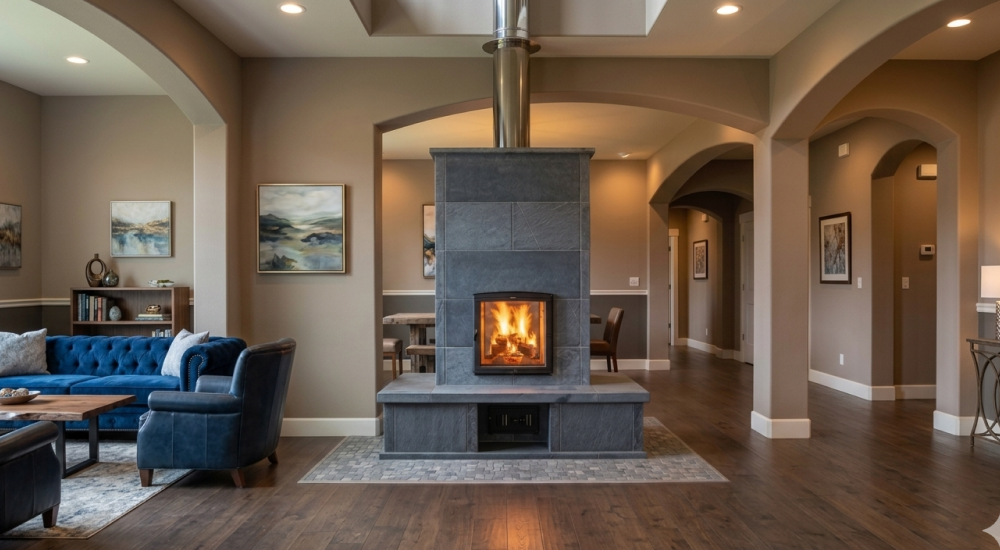
Why the Question Is More Nuanced Than It Seems
When someone asks whether a masonry heater can heat their whole house, they are really asking three questions at once.
First, does the heater produce enough total heat energy to overcome the home’s heat loss? Second, can that heat reach all parts of the home in a useful way? Third, does it do this reliably, without requiring constant attention?
The first question is almost always yes for a correctly sized heater. A Greenstone masonry heater operating at 85 to 92 percent combustion efficiency and storing heat in thousands of pounds of soapstone produces a significant and sustained heat output. The total energy delivered over 18 to 24 hours from a single properly loaded fire is more than sufficient to heat most homes in most North American climates.
The second and third questions are where the real variables live. Heat distribution in a home depends on floor plan layout, insulation quality, ceiling height, window area, and whether the home has the kind of open, connected spaces that allow radiant heat to move naturally. Understanding these factors is the difference between a masonry heater that works perfectly as a sole source and one that works better as a primary source with light supplemental heat in outlying rooms.
The key insight: A masonry heater does not heat air and push it around the house the way a furnace does. It heats the core of the home by radiation, and that warmth spreads naturally through connected spaces. Floor plan openness matters more here than it does with forced air.
How a Masonry Heater Actually Heats a Home
To evaluate whether a masonry heater will work for your specific house, it helps to understand the mechanism by which it heats.
A conventional furnace heats air and moves that air through ducts to every room. The system is centrally controlled and reaches every corner of the house mechanically. It is effective but energy-intensive, dependent on electricity, and produces the kind of hot-and-cold cycling that makes many homes feel drafty.
A masonry heater heats by radiation. The soapstone surface, which reaches 140 to 180 degrees Fahrenheit during peak output, emits long-wave infrared radiation that warms solid objects and people directly. Floors, walls, furniture, and the structural mass of the home all absorb this radiant energy and re-radiate it back into the living space. The result is that the entire room gradually warms from the inside out rather than from a duct in the ceiling.
This is the same mechanism by which the sun warms a room through a south-facing window. It works without any mechanical assistance, which is why masonry heaters continue heating your home even when the power is out. And it is why owners consistently describe radiant heat as feeling warmer and more comfortable than forced air, even at a lower air temperature.
The practical implication for whole-house heating is this: the heater works best when it is positioned at the heart of an open, connected floor plan, where radiant energy can travel freely to adjoining spaces. In a home with a central great room, an open kitchen, and bedrooms arranged off a hallway, a well-placed masonry heater can maintain comfortable temperatures throughout the entire living area.
Related reading: Masonry Heater vs. Wood Stove: 8 Benefits That Make the Difference
The Four Factors That Determine Whether It Will Work for Your Home
Home Size and Square Footage
A single Greenstone masonry heater is appropriately sized for homes up to approximately 2,500 to 3,000 square feet in cold climates, when those homes are well insulated and have a reasonably open floor plan. Below 2,000 square feet, a masonry heater consistently and comfortably serves as the sole heat source for the vast majority of customers.
Above 3,000 square feet, a single heater may be sufficient depending on layout, insulation, and climate, but a zone heating strategy, two heaters positioned strategically, or a supplemental backup system for remote areas becomes worth considering.
The right question is not simply how many square feet the home has, but how many square feet are connected and accessible to the heater’s radiant output.
Insulation and Air Sealing Quality
This is the variable that has the single biggest impact on whether a masonry heater can comfortably heat a whole house.
A well-insulated home, R-20 walls, R-40 to R-60 attic, and properly air-sealed windows and doors, loses heat slowly. A masonry heater charging the thermal mass of that home once a day can easily keep pace with the heat loss. A poorly insulated home loses heat faster than any single heating system can economically replace it, regardless of what that system is.
Before investing in a masonry heater as a primary heat source, homeowners in older homes should honestly assess their insulation and air sealing. In many cases, improvements to the building envelope deliver better results, more comfort, and lower heating costs than any change to the heating system.
Practical benchmark: A home that can be comfortably heated by a conventional 60,000 BTU wood stove is almost certainly a good candidate for a masonry heater as the sole heat source. If the wood stove cannot keep up, the issue is usually the building envelope, not the heater.
Floor Plan Layout and Openness
This is where the physics of radiant heat diverge most sharply from forced air.
Radiant heat from a masonry heater travels in straight lines from the soapstone surface. It warms everything it reaches directly, and those warmed surfaces then re-radiate heat into the room. In an open floor plan where the heater sits in a central great room connected to the kitchen, dining area, and primary living space, the radiant energy distributes effectively and the whole zone warms evenly.
In a home with closed-off rooms, long hallways, or spaces separated from the heater by multiple walls and doors, radiant heat has a harder time reaching those areas directly. The air will eventually carry warmth to these spaces, but more slowly and less evenly than in an open plan.
For homes with more compartmentalized layouts, the solution is usually placement strategy rather than a different type of heater. A Greenstone consultant can assess your floor plan and recommend where a single heater, or a two-heater configuration, will deliver the most even coverage across the home.
Climate and Local Heating Load
A masonry heater in coastal Northern California operates in a fundamentally different context than the same heater in a Minnesota winter. The colder the climate and the longer the heating season, the more critical accurate sizing becomes.
Greenstone heaters have been successfully installed as sole heat sources in climates as cold as minus 20 to minus 30 degrees Fahrenheit, in well-insulated homes with appropriate sizing. In milder climates, the same heater will be more than sufficient and may only need one fire every other day during moderate weather.
The relevant metric is not peak outdoor temperature alone, but the total heat loss rate of the home at design conditions. Greenstone’s consultation process helps calculate this based on your home’s actual characteristics and local climate data.
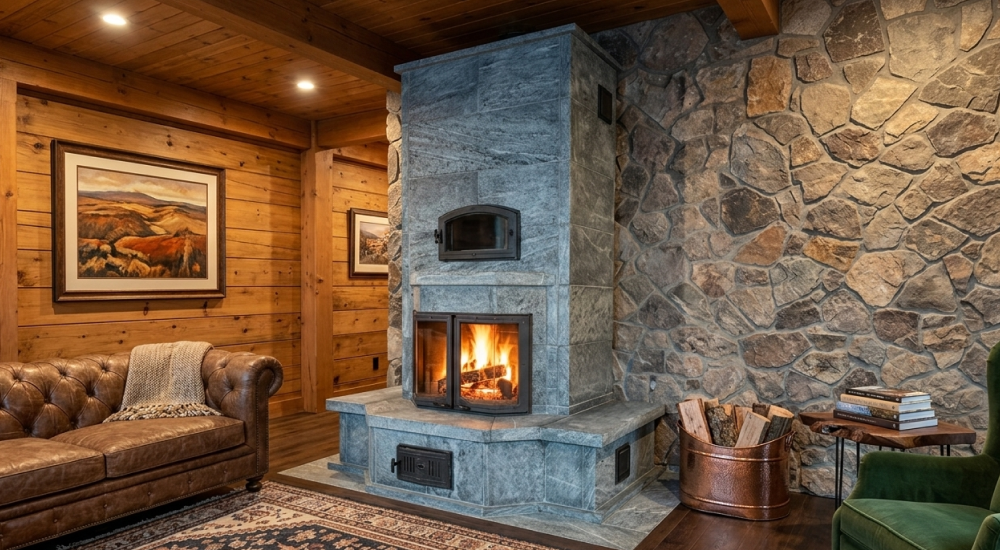
Sizing Guide: Which Greenstone Heater for Which Home
Every Greenstone heater is sized and configured specifically for the project. The table below provides a general starting framework based on home size and floor plan type. Every sizing decision is confirmed through a direct consultation with the Greenstone team.
| Home Size | Heater Series | Wood / Season | Notes |
|---|---|---|---|
| Under 1,500 sq ft | Ricota | 1 to 1.5 cords | Corner design, ideal for smaller open plans |
| 1,500 to 2,500 sq ft | Valencia | 1.5 to 2 cords | Best-selling series, most versatile sizing |
| 2,000 to 3,000 sq ft | Dorchester | 2 to 3 cords | Larger firebox, bay door, ideal for open plans |
| Two adjoining rooms | Cameron | 1.5 to 2.5 cords | Double-sided tunnel, heats both sides simultaneously |
| Over 3,000 sq ft | Custom design | Varies | Zone heating strategy recommended, consult Greenstone |
These are starting guidelines. The actual sizing recommendation will account for your home’s insulation levels, ceiling height, floor plan layout, local climate, and how you want to use the heater. A Greenstone consultation takes all of these into account before making a recommendation.
Related reading: What Is a Masonry Heater? The Ancient Secret Behind the World’s Most Efficient Wood Heat
The Homes Where It Works Best
Based on hundreds of Greenstone installations across North America, certain home types and use patterns consistently produce the best outcomes when a masonry heater is used as the primary or sole heat source.
New construction with planned placement
The most effective masonry heater installations are ones where the heater is planned from the beginning of the design process. This allows the floor plan to be organized around the heater, foundation and structural support to be incorporated properly, flue routing to be optimized, and the heater to be placed at the true geometric center of the home’s heated volume.
When architects and builders plan around a Greenstone heater from the start, the results are consistently excellent. The heater heats the home evenly, efficiently, and with minimal supplemental support.
Well-insulated homes in cold climates
Counter-intuitively, cold climate homeowners who have invested in high-quality insulation and air sealing often find masonry heaters work better for them than for homeowners in milder climates with older, leakier building envelopes. The combination of low heat loss rate and a high-output radiant system is extremely effective.
Passive house and net-zero construction projects have increasingly incorporated Greenstone heaters as the primary heating system, precisely because the low heat loss rate of these buildings pairs well with the slow, steady output of a thermal mass heater.
Open floor plans centered on a great room
The single strongest predictor of whole-house performance is floor plan openness. A home with a great room that flows into the kitchen and dining area, with bedrooms accessible off a short hallway, will heat more evenly and completely from a centrally placed masonry heater than a home with the same square footage divided into separate closed rooms.
Off-grid and rural properties
Masonry heaters require no electricity to operate. There is no blower, no thermostat, no control board, and no mechanical component that can fail during a storm. For off-grid homeowners or those who regularly experience winter power outages, this independence from the electrical grid is not just convenient. It is a serious structural advantage over any forced-air or heat pump system.
Several Greenstone installations serve as the sole heat source for fully off-grid homes in remote cold-climate locations, where the combination of wood heat independence and near-zero electricity requirement is exactly what the homeowner needed.
Where Supplemental Heat Makes Sense
Being direct about this serves buyers better than overpromising.
There are situations where a masonry heater works best as a primary heat source with a light supplemental system covering outlying areas, rather than as the only heat source in the home.
- Homes over 3,000 square feet with compartmentalized floor plans
- Older homes with significant air leakage and poor insulation that cannot be easily improved
- Homes with finished basements or attic spaces far from the heater’s position
- Properties where a backup system is required by code or by the homeowner’s preference for redundancy
- Very cold climates with extended design temperatures below minus 30 degrees Fahrenheit and less-than-optimal insulation
In these situations, the most common approach is to use the masonry heater as the primary system for the main living areas, supplemented by electric baseboard heaters, a mini-split unit, or a small propane system for outlying rooms. The masonry heater still does 80 to 90 percent of the heating work. The supplemental system covers the gap.
This approach typically still delivers the vast majority of the wood savings and comfort benefits associated with masonry heating, while ensuring every corner of the home stays comfortable on the coldest nights.
Related reading: Why Soapstone Is the Ultimate Material for Any Masonry Heater
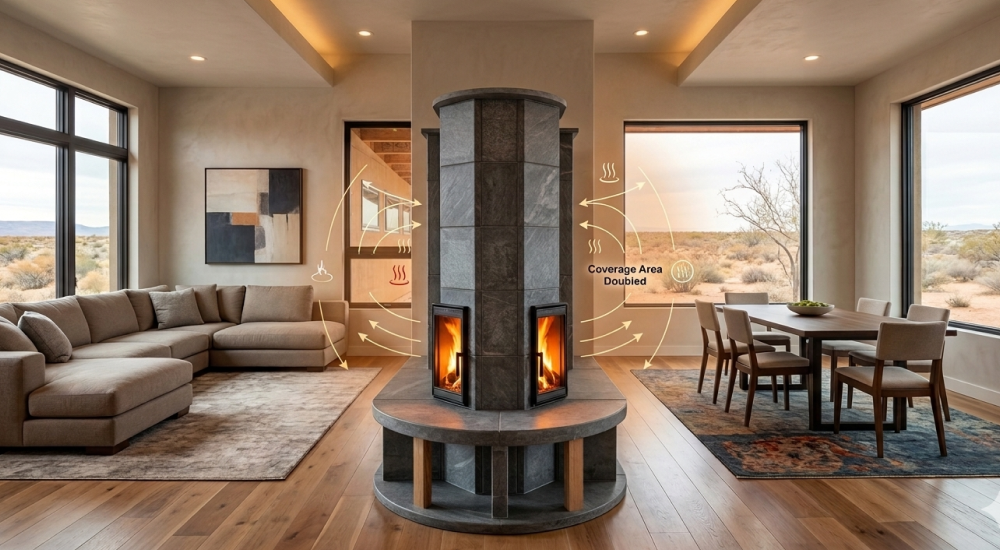
The Cameron Series: Heating Two Spaces at Once
For homes where the primary living area is divided between two connected spaces, such as a great room and a dining room, or a living room and a study, the Cameron series offers a purpose-built solution.
The Cameron features a double-sided tunnel firebox with viewing doors on both the front and back. This design allows a single heater to radiate heat simultaneously into two adjoining spaces, effectively doubling the coverage area of one installation.
The Cameron can be positioned as a room divider between spaces, or built into a structural wall with glass doors on both sides. It is one of the most effective solutions for open-plan homes where the primary living zone spans two connected areas that would otherwise need separate heat sources.
View the Cameron series: Cameron Double-Sided Masonry Heater
Real-World Performance: What Greenstone Customers Report
The numbers are useful. The real-world experience of homeowners who have made the switch is more persuasive.
Across Greenstone’s customer base, the consistent themes in owner feedback are:
- Wood use dropped dramatically. Owners who previously burned 6 to 8 cords per season routinely report using 1 to 2 cords after switching to a Greenstone heater. The savings are immediate and significant.
- The warmth quality surprised them. Almost every owner comments on the difference between radiant warmth and forced air. The even, deep warmth of a soapstone heater is consistently described as more comfortable than anything they experienced with their previous heating system.
- The morning warmth is what they did not expect. Waking up to a home that is still genuinely warm from the previous evening’s fire is the detail that most owners mention first when describing the experience to others.
- The fire routine became enjoyable rather than a chore. Loading a masonry heater once a day, building a focused two to four hour fire, and then being done with it for the day is a fundamentally different relationship with wood heat than constantly managing a wood stove.
- Off-grid confidence. For owners in areas with unreliable power, the ability to heat and cook through winter storms without any electrical dependency consistently ranks as one of the most valued features.
Frequently Asked Questions
How large a home can a masonry heater heat?
A single Greenstone masonry heater can serve as the primary heat source for homes up to approximately 2,500 to 3,000 square feet in cold climates, assuming reasonable insulation quality and an open or semi-open floor plan. Smaller, well-insulated homes in that range can often be heated entirely by one heater with no supplemental system. Larger homes or those with complex layouts may benefit from a two-heater configuration or supplemental backup in outlying rooms.
Can a masonry heater replace my furnace entirely?
For many homeowners, yes. Greenstone customers regularly decommission their oil, gas, or electric furnaces after installing a masonry heater, using the masonry heater as their sole heat source. Whether this is practical for your home depends on your home’s size, insulation, floor plan layout, and local climate. A Greenstone consultation will give you an honest assessment based on your specific situation.
What happens on very cold nights? Will the heater keep up?
A correctly sized masonry heater holds more heat in its stone mass than the home loses on most cold nights. In extreme cold snaps, firing the heater twice a day, once in the morning and once in the evening, keeps the thermal mass fully charged and the home comfortable. Greenstone heaters have been successfully installed as sole heat sources in climates with design temperatures as low as minus 20 to minus 30 degrees Fahrenheit in properly insulated homes.
Does a masonry heater work in a home with a complicated floor plan?
It depends on how compartmentalized the layout is. Open plans with connected living areas distribute radiant heat effectively from a centrally placed heater. Homes with many closed rooms, long hallways, or areas on different levels from the heater may see uneven distribution in remote spaces. Greenstone consultants review floor plans as part of the sizing process and can recommend heater placement or configuration strategies that maximize coverage for your specific layout.
How does heating work when I go away for a few days in winter?
This is a genuine consideration for masonry heater owners. When a heater is not fired for several days in cold weather, the thermal mass cools and the home’s temperature will drop. Most owners use a backup system, even a modest electric baseboard or thermostatically controlled propane unit, to maintain a minimum temperature when they are away. When they return, a few fires restore the heater to full operating temperature and the home returns to its normal comfort level within hours.
How long does it take for the heater to warm a cold house?
If starting from a fully cold heater and a cold house, it typically takes 24 to 48 hours of regular firing to fully charge the thermal mass and bring the home to comfortable temperature. Once at operating temperature, a single daily fire maintains it. For this reason, most masonry heater owners leave their heater running throughout the heating season rather than allowing it to go cold between firings.
Will a masonry heater heat my basement?
Radiant heat from the heater’s surface will warm the floor area directly below and around the heater, which can benefit an open basement stairwell or partially finished lower level. However, a fully finished basement with closed walls and ceilings separated from the heater by a floor assembly will not receive significant direct radiant heat. A separate heat source for the basement is typically recommended in those cases.
Does placement in the home matter a lot?
Yes, significantly. A masonry heater placed at the geometric center of the home’s heated volume, in an open living area, will distribute heat more evenly than one placed against an exterior wall or in a less central location. Greenstone works directly with your architect and builder to determine the optimal placement before construction begins, which is why new construction projects tend to produce the best heating results.
The Straight Answer
Can a masonry heater heat your whole house? For most homeowners who are building or renovating with intention, who have reasonable insulation, and who are working with an open or semi-open floor plan, the answer is yes. Not probably. Yes.
The homes where it works best are the ones where the heater is planned into the design from the start, positioned centrally, and sized accurately for the home’s actual heat loss. Those projects consistently produce the results that Greenstone’s customers describe: a warm house every morning, dramatically less wood burned, and a heating experience that feels fundamentally different from anything they had before.
The homes where supplemental heat makes sense are honest edge cases, not reasons to doubt the technology. And even in those cases, the masonry heater does most of the work, most of the time.
The best way to get a definitive answer for your specific home is a direct conversation with the Greenstone team. They will review your floor plan, insulation levels, local climate, and heating goals, and give you a clear recommendation rather than a guess.
Find Out if a Masonry Heater Is Right for Your Home
Greenstone works with homeowners, architects, and custom builders across North America to size, design, and install soapstone masonry heaters that work as the primary heat source for the home. Every project begins with an honest conversation about your home, your climate, and what you actually need.
Begin Your Custom Design Consultation
Every Greenstone heater is sized, designed, and installed specifically for your home. If you are ready to find out whether a masonry heater can be your primary heat source, the conversation starts with a single call.
Custom sizing consultation | Nationwide installation | Soapstone built to last a lifetime
Request a Quote | Contact Us | Browse the Gallery
Or call us toll-free: 855-826-9246