

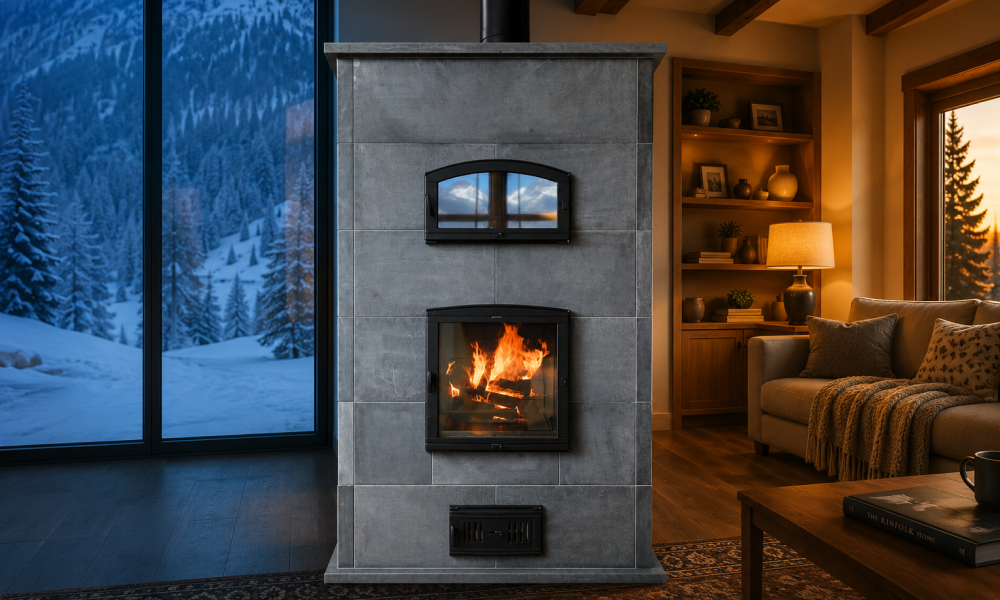
Walk into a cold house on a February morning and the first thing you want is heat — now, not in two hours. That is the practical reality behind what heating professionals call the 30-minute heating rule: the idea that a well-designed heating system should begin delivering meaningful warmth within the first thirty minutes of operation, without burning excessive fuel to get there.
The rule is not a formal standard with a governing body behind it. It is a practical benchmark that separates efficient heating systems from inefficient ones. And when you understand what it actually measures, it becomes clear why soapstone masonry heaters — built the way we build them at Greenstone — meet this standard in a way that conventional wood stoves and forced-air systems simply cannot match.
See also: How Masonry Heaters Work: The Complete Guide to Radiant Heating
What the 30-Minute Heating Rule Actually Means
The rule is often misunderstood. It does not mean that an entire house should reach its target temperature in thirty minutes. For most homes, that is physically impossible regardless of the heating system. What it does mean is that a heating appliance should transition from cold start to productive heat output within that window — combustion reaching operating temperature, heat beginning to transfer into the living space, and the occupants starting to feel the difference.
Think of it as a performance threshold rather than a finish line. A heating system that warms your immediate environment within thirty minutes is working correctly. One that requires two hours of smoldering before it does anything useful is wasting fuel, producing excessive smoke, and delivering a poor experience.
The rule applies across all heating systems — wood stoves, masonry heaters, fireplace inserts, forced-air furnaces — but each system reaches the threshold in a fundamentally different way. Understanding those differences is where the comparison gets interesting.
How Different Heating Systems Approach the 30-Minute Threshold
Conventional Wood Stoves
A modern EPA-certified wood stove is designed to reach combustion efficiency quickly. Within roughly thirty minutes of lighting, the firebox stabilizes at operating temperature, secondary combustion activates to burn off remaining gases, and radiant heat begins projecting from the stove’s surface into the room.
The limitation is what happens after those thirty minutes. The heat output is tied directly to the fire — the moment combustion slows, the room begins cooling. To maintain warmth, you reload the firebox. A typical wood stove requires four to six fire cycles per day in cold weather, each one requiring attention and fuel. The 30-minute rule is met in terms of initial heat production, but maintaining that warmth is an ongoing labor.
See also: Masonry Heater vs. Wood Stove: 8 Benefits That Make the Difference
Forced-Air Furnaces
A forced-air system reaches the 30-minute threshold easily — warm air is circulating within minutes of the thermostat calling for heat. The drawback is that convective heat, which warms the air rather than the occupants and surfaces directly, creates temperature stratification. Hot air rises to the ceiling while floor level stays cooler. The moment the furnace cycles off, the air cools quickly and the cycle repeats.
See also: Why Is Radiant Heat More Efficient Than Convection Heat?
Soapstone Masonry Heaters
A masonry heater meets the 30-minute rule differently from both systems above — and in doing so, it solves the underlying problem rather than just meeting the threshold.
When you light a Greenstone masonry heater, combustion temperatures rise rapidly in the first thirty minutes. The firebox reaches 1,200 degrees Fahrenheit or higher. The internal channels begin absorbing thermal energy. The soapstone surface starts warming. The 30-minute threshold is met in terms of heat production — but unlike a wood stove or furnace, that heat does not disappear when the fire goes out.
A full burn cycle in a Greenstone heater lasts two to four hours. During that time, thousands of pounds of soapstone absorb the generated heat. Once the fire is out, the stored energy radiates slowly and evenly into the room for the next 18 to 24 hours. One fire per day. One 30-minute startup. Continuous warmth until the following evening.
The Greenstone difference: most heating systems meet the 30-minute rule and then require constant attention to sustain it. A soapstone masonry heater meets it once per day and lets the stone do the rest.
See also: Masonry Heater Efficiency Explained: 90%+ Combustion Rates
Why Soapstone Specifically Makes the Difference
Not all masonry heaters are built from the same materials. Greenstone heaters are built around soapstone — a dense, talc-based metamorphic rock with thermal properties that make it the most effective heat storage material available for residential heating.
Soapstone has a thermal conductivity of 6 to 12 W/m·K, which is significantly higher than brick or concrete. This means it absorbs heat rapidly during the burn cycle — capturing energy efficiently within the 30-minute window rather than allowing it to escape up the flue. Once absorbed, it releases that energy slowly and evenly, maintaining a surface temperature of 140 to 180 degrees Fahrenheit long after combustion has ended.
That surface temperature is important in another context. At 140 to 180 degrees, the soapstone is warm to the touch and deeply comfortable — but it will not cause burns on accidental contact, unlike the 400 to 600-degree surface of a conventional wood stove. Families with children and pets can be in the same room freely.
See also: Why Is Soapstone the Ultimate Material for Any Masonry Heater?
See also: Are Masonry Heaters Safe for Families With Children and Pets?
The Factors That Determine Performance in the First 30 Minutes
Whether any heating system meets the 30-minute threshold consistently depends on a set of controllable variables. Understanding these helps homeowners get the best performance from their appliance from day one.
Fuel Quality
For wood-burning systems, fuel moisture content is the single most important variable. Seasoned firewood with moisture content below 20 percent — ideally below 15 percent — burns hotter, ignites faster, produces significantly less smoke, and reaches combustion temperature more quickly than wet wood. Green or freshly cut wood does the opposite: it smolders, delays heating, and coats the flue with creosote.
At Greenstone, we recommend hardwoods — oak, ash, maple, and birch — that have been split and dried for at least 12 to 18 months. A properly seasoned load produces a noticeably different fire from the first minutes of ignition.
See also: Why Is Locally Sourced Firewood a Green and Sustainable Heating Solution?
Starting Technique
A top-down fire-starting method — kindling on top of the main fuel load, ignited from above — produces cleaner combustion from the start and reaches operating temperature faster than a bottom-up fire that smolders while working through cold wood. The top-down method is the approach we recommend in the Greenstone User Guide.
See also: Greenstone User Guide
Airflow and Damper Position
During the startup phase, combustion air should be fully open. Restricting the air supply to a cold firebox slows the temperature rise and pushes the 30-minute threshold further out. Once the firebox is at operating temperature, damper adjustments can fine-tune the burn rate.
Home Insulation
Even the most efficient heating system is working against itself in a poorly insulated home. Heat generated in the first thirty minutes escapes through walls, windows, and air leaks before occupants feel it. Sealing drafts and ensuring adequate wall and ceiling insulation allows the heat produced in the initial burn phase to stay where it belongs — in the living space.
Appliance Sizing
A heater that is undersized for the space it is heating will struggle to meet the 30-minute benchmark because it is generating insufficient output for the volume of air it needs to warm. A heater that is oversized runs inefficiently and creates excessive temperature swings. Greenstone sizes every heater specifically to the home’s square footage, climate zone, and insulation level — a process that begins with a direct consultation before any design work starts.
Common Misconceptions Worth Addressing
“The house should be fully warm in 30 minutes”
This misreads the rule. The benchmark is heat production from the appliance, not full temperature equalization across every room. In a well-insulated home with a properly sized Greenstone heater, the living areas surrounding the heater will be noticeably warm within thirty minutes. Peripheral rooms take longer, but the heater has met its performance threshold.
“Slower fires use less fuel”
This is one of the most persistent and damaging misconceptions in wood heating. A smoldering, low-temperature fire produces incomplete combustion — a significant portion of the fuel’s energy is lost as smoke and unburned gases rather than converted to heat. The result is worse performance, more creosote buildup, and higher long-term fuel costs. A hot, efficient burn produces more heat from less wood. This is the entire premise behind masonry heater design: one intense burn per day rather than continuous low-temperature smoldering.
“Masonry heaters take too long to warm a home”
This is the misconception we hear most often from homeowners considering their first masonry heater. The reality is that the stone begins absorbing and radiating heat from the moment combustion starts. The heater’s full thermal output develops over the two-to-four-hour burn cycle, but the surface is already warming the room during the first thirty minutes. And because the previous day’s fire has kept the stone warm overnight, morning cold starts in a home with an established burn routine are rarely as dramatic as new owners expect.
What This Means for Long-Term Heating Costs
The 30-minute rule has direct financial implications. A heating system that meets it efficiently uses less fuel per unit of heat produced. Over a full heating season, that efficiency compounds significantly.
A conventional wood stove heating a 2,000 square foot home in a cold climate typically burns six to eight cords of wood per season. A Greenstone masonry heater heating the same home burns one to three cords. At current cord wood prices of $200 to $400 per cord in most regions, that difference represents $1,000 to $2,800 in annual savings — every year, indefinitely, for the life of the heater.
Most Greenstone owners report full investment payback within five to seven years through wood savings alone. After that, the heater produces ongoing savings for the rest of its operational life — which is measured in generations, not years.
See also: Masonry Heater ROI: Why Your 5-7 Year Investment Pays Off
The Bottom Line
The 30-minute heating rule is a useful way to think about heating performance, but it only tells part of the story. Any heating system can be engineered to produce heat quickly. What separates a soapstone masonry heater from every other option is what happens after those thirty minutes.
The heat that enters the stone during the initial burn does not escape up the chimney or dissipate the moment the fire dies. It stays in the stone and radiates into your home steadily for the next full day. You light one fire. The stone does the rest.
That is the difference between a heating system that technically meets a benchmark and one that fundamentally rethinks how a home stays warm.
Ready to Heat Your Home the Right Way?
Greenstone is the only American-made custom soapstone masonry heater — designed and installed nationwide. Every project starts with a direct conversation about your home, your heating goals, and what you want at the centre of it.
Request a Quote | Contact Us | Browse the Gallery
Or call us toll-free: 855-826-9246