

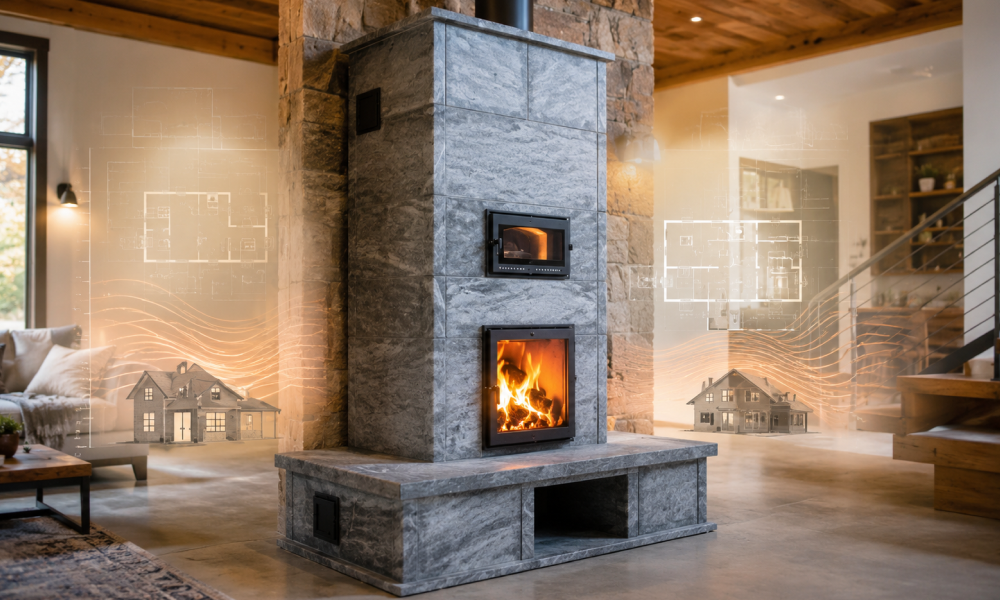
“Will this actually heat my whole house, or am I just buying a beautiful rock for the corner of one room?”
We hear some version of that question on almost every first call. It is a fair thing to worry about, and the honest answer is that it comes down entirely to sizing. Get it right, and the heater becomes the only heat source most of our clients ever need. Get it wrong, and you end up either shivering on the coldest nights or sweating out an overheated room while the rest of the house stays cold.
An undersized heater never quite catches up when it matters most. An oversized one dumps too much heat into one space before the rest of the home benefits at all. Neither is a fun place to end up after spending real money on a custom heater.
The good news is that sizing is not a mystery. It comes down to matching the heater’s stone mass and firebox to your square footage, your layout, and your climate. Here is exactly how we think about it, using our five core series as real reference points.
What Determines Masonry Heater Size
Three things matter more than anything else.
- Square footage: not just the raw number, but how open or closed off your floor plan actually is
- Climate zone: colder regions need more stored heat to make it through a longer, harder night
- Insulation and construction: a tightly built, well-sealed home holds heat far longer than an older, drafty one of the exact same size
As a rough rule of thumb, a properly sized Greenstone heater can be the only heat source a home up to roughly 2,500 to 3,000 square feet ever needs. Past that, or in a home with a complicated multi-level layout, we will usually suggest either stepping up to a larger configuration or pairing the heater with a secondary heat source for the rooms farthest away from it.
Masonry Heater Sizes by Square Footage
Each of our five core series is built around a specific space range. Think of these as starting points, not rigid boxes. Every heater we build is still custom designed around your home, but they will give you a realistic frame of reference before we ever talk.
| Series | Space to Heat | Footprint | Best For |
|---|---|---|---|
| Valencia | Up to 1,500 sq ft | Compact footprint | Best-selling, flexible configurations, tunnel version, mantles |
| Ricota | Up to 1,300+ sq ft | 44″ x 27″ | Corner installations, small to medium spaces |
| Socorro | 1,400 to 1,600 sq ft | 38″ x 24″ | Best value, double-sided, tunnel doors available |
| Cameron | Up to 1,600 sq ft | 45″ x 32″ | Room divider, see-through firebox, fire viewing from both sides |
| Dorchester | Up to 1,800 sq ft | Largest firebox | Largest spaces and coldest climates, three-sided bay door |
Valencia Masonry Heater: Best for Homes Up to 1,500 Sq Ft
The Valencia is the one most of our clients end up choosing, and there is a reason for that. It has a compact footprint that fits comfortably into most living rooms, and you can build it as a tunnel configuration with a front or back bake oven if you want one. If you are not sure where to start, start here.
Ricota Masonry Heater: Best for Corner Installations, Up to 1,300 Sq Ft
The Ricota was built specifically for corners. If your floor plan does not give you a clean, open wall section to work with, this is usually the answer. It handles up to roughly 1,300 square feet and still gives you the option of a bake oven and a wide range of bench styles.
Socorro Masonry Heater: Best Value for 1,400 to 1,600 Sq Ft Homes
The Socorro is, dollar for dollar, the best value we offer relative to performance. At 38 by 24 inches, it heats 1,400 to 1,600 square feet and comes in double-sided and tunnel door configurations if you want flexibility without paying for a larger series.
Cameron Masonry Heater: Room Divider Design for Up to 1,600 Sq Ft
The Cameron earns its keep by doing double duty. Its see-through firebox makes it a natural room divider, say, between an open kitchen and the living room, with fire viewing from both sides. It still heats up to 1,600 square feet despite the unusual shape.
Dorchester Masonry Heater: Largest Series for Homes Up to 1,800 Sq Ft
The Dorchester carries the biggest firebox in our lineup and is built for the toughest climates: Colorado mountain homes, off-grid properties in Montana or Wyoming, anywhere winters run long and brutal. Heats up to 1,800 square feet, and its three-sided bay door gives you the widest fire view of anything we make.
See also: View technical drawings and dimensions for every series.
See also: What Is a Masonry Heater? The Ancient Secret Behind the World’s Most Efficient Wood Heat.
Masonry Heater Sizing by Climate Zone
Square footage alone never tells the whole story. A 1,600 square foot home on the coast of North Carolina and a 1,600 square foot home in Anchorage face two completely different winters, even with identical floor plans.
This is where climate comes in. Colder regions need a heater with more stored heat in the stone to make it through a longer, colder night on a single burn. A heater that performs beautifully in a mild climate might need firing twice a day somewhere harsher, simply because the gap between indoor and outdoor temperature is so much bigger.
Our teams working in Danbury, New Hampshire and Anchorage, Alaska see this play out constantly. Homes in those regions are often sized up one tier from what the square footage alone would suggest, purely to account for the climate.
A heater sized right for a mild climate will leave you cold somewhere harsher. That is exactly why sizing is never a simple square-footage lookup, it is a conversation about your specific home, in your specific location.
How Home Insulation Affects Masonry Heater Size
Here is something people do not expect: two identical floor plans can need two completely different heater sizes, just based on how well each home holds heat. A new, tightly sealed, well-insulated build holds the warmth a heater produces for far longer than an older home with single-pane windows and thin wall insulation.
If you are building new, this actually works in your favor. A properly insulated build often lets you go with a smaller heater than the square footage alone would suggest, because you are not losing heat through every wall and window gap. If you are retrofitting an older home, it is worth closing up the major insulation gaps before or alongside the heater install. No heater, masonry or otherwise, can out-produce a home that is constantly leaking the heat it just made.
See also: Why Is Radiant Heat More Efficient Than Convection Heat?
How Many Fires Per Day Does the Right Size Need?
Most Greenstone owners light their heater once or twice a day, depending on the outdoor temperature and the size of the home. In mild weather, one evening fire usually carries a properly sized heater’s warmth well into the following afternoon. On the coldest stretches of winter, a morning fire and an evening fire cover almost everything.
That rhythm is the real payoff of getting the size right. An undersized heater forces you into more frequent fires just to keep pace. A correctly sized one settles into that easy one or two fire per day pattern that makes masonry heating feel almost effortless compared to babysitting a conventional wood stove all day.
See also: Masonry Heater vs. Wood Stove: 8 Benefits That Make the Difference.
See also: Masonry Heater Efficiency Explained: 90%+ Combustion Rates.
Why Masonry Heater Sizing Needs a Real Conversation
No chart can account for every variable: your exact layout, how open or closed your floor plan is, your local climate, your insulation, and how you actually plan to live with the heater day to day. Getting it right is part science, part judgment built from doing this for a long time.
That is exactly why every Greenstone project starts with a real conversation, not a generic recommendation off a spec sheet. We will ask about your square footage, your location, how your home is built, and how you picture using the heater, then point you toward the series and configuration that genuinely fits.
See also: How to Prepare Your Home for Masonry Heater Installation.
Choosing the Right Masonry Heater Size for Your Home
Getting the size right is, hands down, the most important decision in this whole process. It matters more than the exterior finish, the bench style, or whether you add a bake oven. Size it correctly and you get the one-fire-a-day comfort that makes this kind of heating worth doing in the first place. Size it wrong and you are stuck either cold or fighting an overheated room.
Use the table above as your starting point. Be honest with yourself about your climate. And bring the real details of your home to that first conversation with us, that is where the actual sizing happens.
Not Sure Which Series Fits Your Home?
Tell us your square footage, location, and layout, and we will recommend the right Greenstone series for your home, no obligation.
Request a Quote| Browse all series
Or call us toll-free: 855-826-9246