

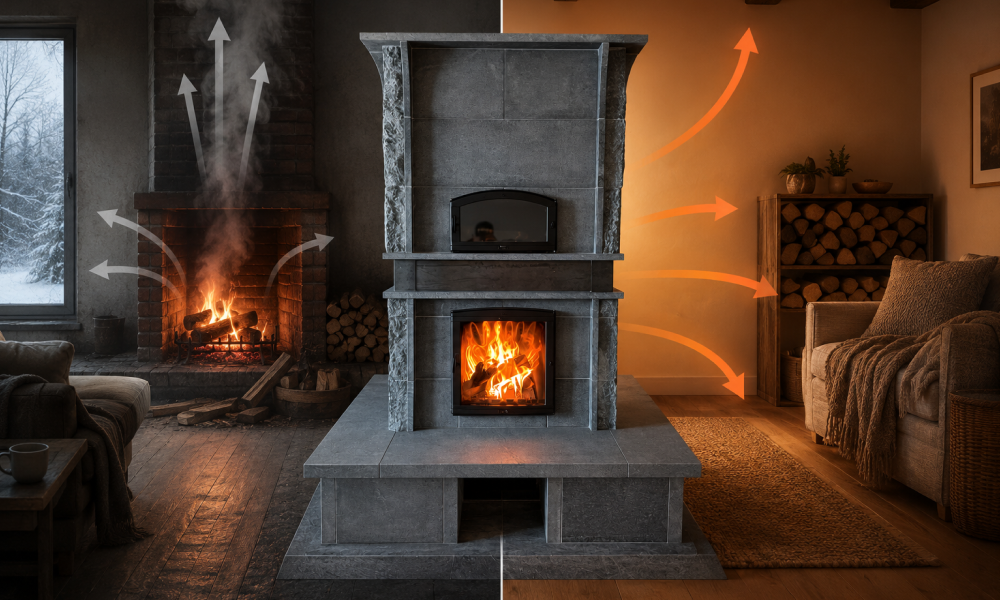
Most people who look into masonry heaters ask about the cost of buying one. Far fewer stop to ask about the cost of not buying one. That is actually the more interesting question.
If you currently heat with a traditional wood-burning fireplace, you are almost certainly spending more on firewood every single year than you need to. A traditional fireplace is one of the least efficient ways to heat a home ever designed. It burns through wood at a staggering rate, sends the majority of that heat up the chimney, and in many cases actually pulls warm air out of your house through the flue when the fire is not burning.
A Greenstone soapstone masonry heater works entirely differently. It burns hotter, cleaner, and far more efficiently, and it stores that heat in thousands of pounds of soapstone to keep your home warm for 18 to 24 hours on a single fire. The fuel savings are not marginal. They are dramatic. And they compound every year for the life of the heater, which is measured in generations.
Here is exactly how the numbers work out.
See also: What Is a Masonry Heater? The Ancient Secret Behind the World’s Most Efficient Wood Heat
Why Traditional Fireplaces Are So Expensive to Run
A traditional open fireplace operates at negative efficiency in many cases. That is not a typo. Because the flue must remain open during a fire, and often for hours afterward while coals cool, a fireplace actively draws conditioned air out of your home and replaces it with cold air drawn from outside. You are heating the room immediately in front of the fire while the rest of the house gets colder.
Even when a fireplace is producing heat, it is doing so inefficiently. Most of the energy in the wood escapes as hot gas up the chimney rather than radiating into the room. The result is a large firebox that requires constant reloading, burns through six to eight cords of wood per heating season in a cold climate, and still leaves the far corners of your home cold.
Compare that to a masonry heater, which burns at combustion efficiency rates of 80 to 90 percent or higher, stores that heat in dense soapstone, and releases it slowly and evenly over the following 18 to 24 hours. The same home. Completely different outcome.
See also: Masonry Heater Efficiency Explained: 90%+ Combustion Rates
See also: Why Is Radiant Heat More Efficient Than Convection Heat?
The Wood Cost Calculation
The numbers below are based on real-world data from Greenstone customers and reflect average cord wood prices across the US. Wood prices vary significantly by region and species. We have used conservative estimates throughout to keep these projections realistic rather than optimistic.
| Annual Firewood Cost Comparison: Traditional Fireplace vs Greenstone Masonry Heater | ||
| Traditional Fireplace | Greenstone Masonry Heater | |
| Cords of wood burned per year | 6 to 8 cords | 1 to 2 cords |
| Average cord price (US average) | $300 to $400 | $300 to $400 |
| Annual wood cost | $1,800 to $3,200 | $300 to $800 |
| Fires required per day | Multiple throughout the day | 1 to 2 per day |
| Hours of heat per fire | 1 to 2 hours (fire only) | 18 to 24 hours (stored heat) |
| Combustion efficiency | Negative to 20% | 80 to 90%+ |
| Annual savings with masonry heater | Baseline cost | Save $1,500 to $2,400 per year |
The middle-of-the-road scenario tells the story clearly. A homeowner burning seven cords per year at $350 per cord is spending $2,450 on firewood. The same homeowner with a Greenstone masonry heater burning one and a half cords per year at the same price is spending $525. That is a saving of $1,925 per year, from wood costs alone.
Our customers consistently report saving around $1,600 per year on average. Some save considerably more, particularly those in colder climates who were burning eight or more cords before.
Real customer data: Greenstone owners report reducing wood usage from 7 to 8 cords per year down to 1 to 2 cords. At average US cord prices of $300 to $400, that is roughly $1,600 in savings every year.
See also: Masonry Heater ROI: Why Your 5-7 Year Investment Pays Off
Hours of Heat: Getting More from Every Log
Wood cost per cord is only part of the equation. What matters equally is how many hours of useful heat you get from each cord burned. This is where the difference between a fireplace and a masonry heater becomes especially clear.
| Heat Output Comparison: Hours of Warmth per Cord of Wood | ||
| Traditional Fireplace | Greenstone Masonry Heater | |
| Combustion temperature | Low (incomplete burn) | 1,100 to 1,500 degrees F |
| Heat extraction from wood | 10 to 20% of available energy | 80 to 90% of available energy |
| Duration of heat per fire | Heat only while fire burns | 18 to 24 hours after fire is out |
| Refueling frequency | Every 1 to 2 hours while active | Once or twice per day |
| Useful heat hours per cord | Approximately 12 to 20 hours | Approximately 120 to 160 hours |
| Effective heat per cord | Low | 6 to 8 times more useful heat |
Put simply, one cord of wood burned in a Greenstone masonry heater produces roughly six to eight times more useful heat than one cord burned in a traditional fireplace. This is not marketing language. It is the direct result of the difference between 15 percent combustion efficiency and 90 percent combustion efficiency, combined with the soapstone’s ability to store and release heat over an extended period.
This is also why masonry heater owners consistently describe the experience as different in quality, not just quantity. The home is warm when they wake up, without anyone getting up through the night to reload a firebox.
See also: Thermal Mass Heater vs Traditional Fireplace: Full Comparison
Sample Calculations by Climate Region
Where you live affects the numbers significantly. Here are three realistic scenarios based on different climate zones, using actual regional cord wood prices and typical heating season lengths.
Scenario 1: Mild Climate (Oregon, Washington, Northern California)
Heating season of roughly 5 months. Typical fireplace burns 4 to 5 cords per year. Cord wood price in these regions averages $280 to $320.
| Mild Climate Annual Savings Estimate | ||
| Traditional Fireplace | Greenstone Masonry Heater | |
| Cords burned annually (fireplace) | 4.5 cords | |
| Annual wood cost (fireplace) | $1,305 | at $290/cord average |
| Cords burned annually (masonry heater) | 1 to 1.5 cords | |
| Annual wood cost (masonry heater) | $360 | at $290/cord average |
| Estimated annual saving | $945 per year | |
Scenario 2: Cold Climate (Colorado, Vermont, Minnesota, Montana)
Heating season of 6 to 7 months. Typical fireplace burns 7 to 8 cords per year. Cord wood in these regions averages $320 to $380.
| Cold Climate Annual Savings Estimate | ||
| Traditional Fireplace | Greenstone Masonry Heater | |
| Cords burned annually (fireplace) | 7.5 cords | |
| Annual wood cost (fireplace) | $2,625 | at $350/cord average |
| Cords burned annually (masonry heater) | 1.5 to 2 cords | |
| Annual wood cost (masonry heater) | $612 | at $350/cord average |
| Estimated annual saving | $2,013 per year | |
Scenario 3: Severe Cold Climate (Maine, Wyoming, Alaska, New Hampshire)
Heating season of 7 to 8 months. Typical fireplace burns 8 to 10 cords per year. Cord wood in these regions averages $350 to $420.
| Severe Cold Climate Annual Savings Estimate | ||
| Traditional Fireplace | Greenstone Masonry Heater | |
| Cords burned annually (fireplace) | 9 cords | |
| Annual wood cost (fireplace) | $3,510 | at $390/cord average |
| Cords burned annually (masonry heater) | 2 cords | |
| Annual wood cost (masonry heater) | $780 | at $390/cord average |
| Estimated annual saving | $2,730 per year | |
See also: What Size Masonry Heater Do I Need? A Practical Guide by Home Size and Climate
Cumulative Savings Over Time
The real case for a masonry heater becomes clearest when you extend the calculation over time. Using the cold climate scenario above ($2,013 per year in wood savings), here is how the savings accumulate over the life of a typical homeowner’s relationship with their heater.
| Period | Estimated Cumulative Savings | Note |
| Year 1 | $1,600 | Wood savings alone |
| Year 3 | $4,800 | Cumulative wood savings |
| Year 5 | $8,000 | Approaching payback threshold |
| Year 7 | $11,200 | Full investment recovered |
| Year 10 | $16,000 | Pure savings from year 7 onward |
| Year 20 | $32,000 | Lifetime savings compounding |
Most Greenstone owners recover their full investment through wood savings within five to seven years. After that, the heater continues producing the same savings indefinitely. A heater installed today and cared for properly will still be heating the same home in 50 years.
The savings above also do not account for reduced chimney cleaning costs, lower maintenance requirements compared to a fireplace, or the property value that a custom soapstone masonry heater adds to a high-end home. Those are real benefits that improve the economics further.
A Greenstone masonry heater pays for itself in savings within 5 to 7 years. After that, every cord not burned is money staying in your pocket, year after year, for the lifetime of the heater.
Savings People Often Miss
Wood costs are the most visible saving, but they are not the only one. Greenstone owners consistently report a few other financial benefits that are easy to overlook when running the initial numbers.
Reduced Secondary Heating Bills
Because a masonry heater raises the mean radiant temperature of the home, occupants feel comfortable at lower air temperatures. Our experience across many customer homes shows a 40 to 75 percent reduction in secondary heating system fuel consumption after a masonry heater is installed. For homes that use propane, oil, or electric as a backup, this is a meaningful additional saving on top of the wood cost reduction.
Lower Chimney Cleaning Frequency
A traditional fireplace produces significant creosote buildup because of its incomplete, low-temperature combustion. Most fireplace owners need a professional chimney sweep at least once per year. A masonry heater burns so cleanly at such high temperatures that creosote buildup is minimal. Many owners go two or more years between professional cleanings, saving $150 to $300 per cleaning cycle.
No Electricity Required
A masonry heater requires no electricity to operate. No blower, no thermostat, no ignition system. In an outage, your home keeps warming from the previous fire’s stored heat for 18 to 24 hours without any power at all. For homeowners in remote or off-grid locations, this is not a minor benefit.
See also: Are Masonry Heaters Safe for Families With Children and Pets?
See also: Masonry Heater vs. Wood Stove: 8 Benefits That Make the Difference
The Bottom Line on Savings
The question is not really whether a masonry heater saves money. The data makes that clear. The question is how to think about a $20,000 to $30,000 investment in the context of what it replaces.
If you are currently spending $2,000 or more per year on firewood for a traditional fireplace and getting inadequate heat in return, a Greenstone masonry heater pays for itself in savings within five to seven years, and then keeps delivering those savings for another 40 or 50 years. No other heating upgrade offers that combination of performance, longevity, and financial return.
The numbers above use conservative estimates. Your actual savings will depend on your current wood usage, your local cord prices, your climate, and how well your home is insulated. To get a calculation specific to your situation, the best starting point is a direct conversation with our team.
See also: Masonry Heater ROI: Why Your 5-7 Year Investment Pays Off
Want to Know What You Would Actually Save?
Tell us your current wood usage, location, and home size and we will work through the numbers with you. No obligation, no pressure.
Request a consultation | Browse completed projects
Or call us toll-free: 855-826-9246