

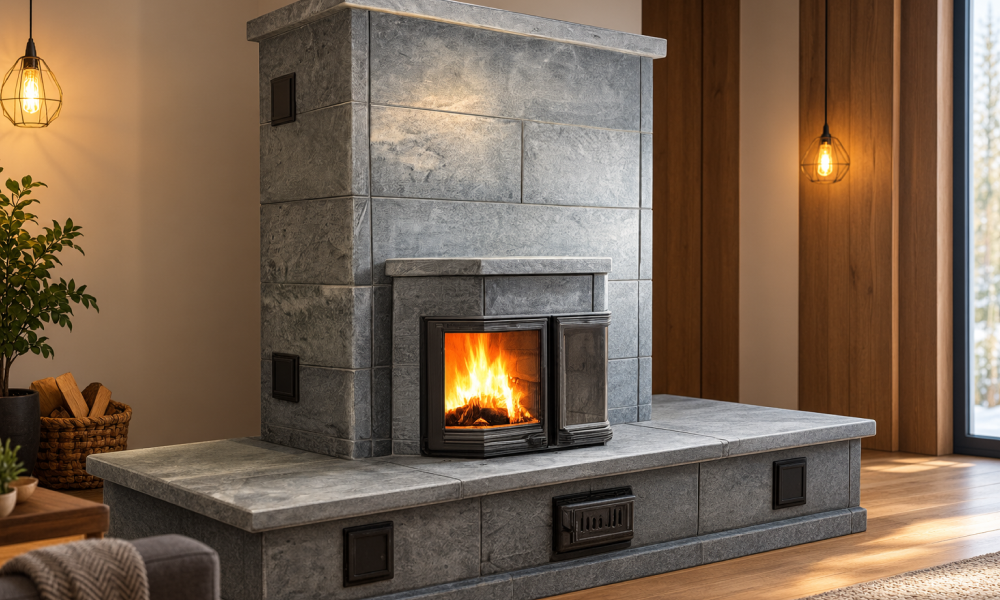
Most wood stoves have a split personality. While the fire is roaring, the stove blasts out heat and the room gets almost uncomfortably warm. Then the last log turns to coals, and within an hour or so, the stove goes cold and so does the room.
A soapstone wood stove behaves differently. Its stone panels soak up heat during the burn and keep releasing it long after the flames have died down, which gives you a steady, gentle warmth instead of that hot-then-cold cycle.
If you have been wondering whether a soapstone wood stove is worth the extra cost, how it compares to the cast iron and steel stoves you have seen in every hardware store, or whether there is something even better out there, this guide covers all of it.
By the end, you will know how these stoves work, what they cost, what to look for when buying one, and when it makes sense to look beyond a stove entirely.
What Is a Soapstone Wood Stove?
A soapstone wood stove is a wood-burning stove built with soapstone, a dense, naturally occurring metamorphic rock, as a major part of its construction. Soapstone formed over millions of years under intense heat and pressure, which is exactly why it handles direct heat so well.
It tolerates repeated heating and cooling without cracking the way many other stones would, and its composition is remarkably stable.
Most soapstone stoves are built with thick soapstone panels wrapped around a steel or cast iron firebox, or with a soapstone lining inside the firebox itself. Some models use soapstone only for the side panels or as decorative inserts, while others use it for most of the exterior.
You will see these called soapstone stoves, soapstone wood burning stoves, or simply stoves with soapstone panels, and the names are used pretty loosely across the industry. What matters is how much soapstone is actually in the build and how thick it is, a point we will come back to in the buying section.
How a Soapstone Wood Stove Stores and Releases Radiant Heat
The core idea is simple. A fire burns inside the firebox and heats the stone. Because soapstone has a high capacity for holding heat, it absorbs a large share of that energy instead of letting it all pour into the room at once.
Once the fire dies down, the stone slowly gives that stored heat back, radiating it outward from its surface.
That outward release is radiant heat, the same kind of warmth you feel from the sun on your face on a cold day. It warms you, the furniture, and the walls directly, rather than just heating the air, which then rises and drifts away.
This is a big part of why a soapstone stove can feel more comfortable at a lower overall room temperature than a steel stove blasting hot air.
Soapstone also conducts heat fairly evenly, so it warms through without developing the sharp hot spots that can crack other stones.
Combined with its heat retention, this is what gives a soapstone stove its signature character: slow to heat up, slow to cool down, and steady the whole way through.
If you want to go deeper on the science, our guide on why soapstone is the ultimate material for masonry heaters breaks down the thermal properties in more detail.
Soapstone Wood Stove Benefits
Longer, Steadier Overnight Burn Time
For most people, the headline benefit is how long the warmth lasts. Because the stone keeps radiating after the fire fades, a soapstone stove can carry a room through the night much better than a metal stove that cools off within an hour or two of the last reload.
You still need to load the stove properly and keep realistic expectations, since results depend on stove size, how much stone it has, and how well your house holds heat. But the overnight advantage is real and is the main reason people choose soapstone.
Gentler Surface Temperatures
Steel and cast iron stoves heat up fast and get very hot on the surface, which makes sitting near them uncomfortable and raises real safety concerns with kids and pets around.
Soapstone releases its heat more slowly, so the surface does not spike the way bare metal does.
That does not make it cool to the touch, a soapstone stove in full operation is still hot and demands the same respect as any wood stove, but the heat tends to feel softer and more even rather than harsh.
Durability and Natural Aesthetics
Soapstone does not rust and does not break down under normal heating cycles, so a well-built soapstone stove can last for decades.
Many owners also appreciate the look. Every slab has its own veining and color variation, ranging from soft grays to deeper greens and blues, and the stone develops a lovely patina over time.
For anyone who wants their stove to be a visual centerpiece instead of just a utilitarian appliance, soapstone has a real advantage. We cover more on this in our overview of soapstone benefits.
Soapstone vs. Cast Iron vs. Steel Wood Stoves
| Feature | Soapstone | Cast Iron | Steel |
| Heat retention | Excellent, releases heat for hours | Moderate | Poor, cools quickly |
| Heat feel | Gentle, even, radiant | Strong but uneven | Intense, then fades |
| Heat-up speed | Slower to warm up | Moderate | Fast |
| Durability | Very high, does not rust or crack easily | High, but can crack over time | Can warp over time |
| Weight | Heavy | Heavy | Lighter |
| Cost (stove only) | $3,000 – $8,000+ | $1,500 – $5,000 | $1,000 – $3,500 |
A common rule of thumb you will see is that soapstone can store roughly twice as much heat per pound as metal. That is a useful way to picture the difference, but it is a general comparison rather than a precise guarantee for every stove model.
The tradeoff is speed. Because soapstone takes longer to absorb heat, a soapstone stove is slower to warm a cold room than a steel stove.
If you want instant heat the moment you light a fire, steel wins that race. If you want steady comfort that lasts, soapstone wins the marathon. It also costs more and weighs more, which brings us to what to look for when you shop.
Does Panel Thickness Matter? What to Look for When Buying
Absolutely, and it is one of the most overlooked details in soapstone stove shopping. Heat retention depends heavily on how much stone is actually there.
As a general guideline, a soapstone stove should have panels at least 30 millimeters (about 1.2 inches) thick to deliver meaningful heat storage, and stoves with soapstone up to around 60 millimeters (about 2.4 inches) thick offer the best heat retention and efficiency.
Be careful with stoves that use only thin decorative soapstone inserts or a small amount of stone around the edges.
They may look the part, but they will not behave like a stove with real thermal mass. Ask the manufacturer exactly how thick the soapstone is and how much of the stove it covers before you commit.
Catalytic vs. Non-Catalytic Soapstone Stoves
You will also run into the terms catalytic and non-catalytic when shopping. Both are designs for burning wood more cleanly and efficiently, and both can be paired with soapstone.
A non-catalytic stove uses a secondary combustion system, with extra air introduced above the main fire to burn off smoke and gases that would otherwise escape up the chimney. These stoves are simpler and need less maintenance.
A catalytic stove routes exhaust through a coated honeycomb element that lets those gases burn at lower temperatures, which can extend burn times and improve efficiency, but the catalytic element needs periodic replacement.
Soapstone pairs especially well with catalytic designs for overnight heat, since the stone keeps releasing warmth while the fire idles at a low setting. Either type works, so the right choice usually comes down to how much maintenance you are willing to take on.
The U.S. EPA guidance on wood-burning appliance efficiency is a good, neutral resource if you want to understand how efficiency is measured and what certified models are held to.
Soapstone Wood Stove Cost: What to Expect
Prices vary a lot by brand, size, and how much soapstone is in the build, but a typical soapstone wood stove often falls somewhere in the range of $3,000 to $8,000 or more for the stove itself.
Smaller stoves and models with limited soapstone sit toward the lower end, while larger models with thick soapstone panels, enamel finishes, or cooking features push toward the higher end.
Remember that the stove price is only part of the total. Installation, chimney or stove pipe, a proper hearth pad, and sometimes a blower can add significantly, depending on your home.
Local labor rates and whether you already have a suitable chimney in place make a big difference.
If you are comparing cost across different heating tiers, including options beyond stoves, our breakdown of masonry heater cost and return on investment shows how pricing changes as you move toward larger, more custom builds.
Clearances, Hearth Requirements, and Installation Basics
Soapstone stoves are heavy, and they follow the same safety rules as any wood stove. That means required clearances from combustible materials such as walls, furniture, and ceilings, a non-combustible hearth pad underneath, and a properly installed, correctly sized chimney or stove pipe.
The exact distances depend on the specific stove model, and the manufacturer’s installation manual is the authority here, not a general guide like this one.
Because of the weight, it is also worth confirming your floor can support the stove, especially in older homes or on upper floors.
Always check local building and fire codes before installing, and have the installation inspected where required. When in doubt, hire a certified installer. A stove that is installed correctly is a stove that performs well and stays safe for decades.
Cooking and Baking on a Soapstone Stove
One fun bonus: some soapstone stoves are built with cooktops or bake ovens, and soapstone has a long history as a cooking surface.
Its even heat makes it a natural fit for baking and slow cooking, and a wood-fired stove that can double as a cooktop is genuinely handy during a power outage.
Not every model has this feature, so if cooking matters to you, look specifically for cookstove models or ask about bake oven options at the time you buy.
Soapstone Wood Stove vs. Soapstone Masonry Heater: What’s the Difference?
This is the question that rarely gets a good answer online, and it is worth slowing down for. A soapstone wood stove and a soapstone masonry heater use the same wonderful material, but they are very different appliances.
A soapstone wood stove is still fundamentally a stove. You build a fire, adjust airflow, and feed it over several hours, and the soapstone panels help smooth out the heat and extend it after the fire fades.
The firebox is relatively small and the stone is a feature built around a metal or lined combustion chamber.
A soapstone masonry heater flips the whole concept. Instead of a small fire feeding a stove for hours, you burn a short, hot, fast fire once or twice a day, and the exhaust is routed through a winding internal channel system built into a large mass of soapstone.
That mass captures most of the heat that would otherwise escape up the chimney, then radiates it slowly into the room for eighteen to twenty-four hours.
Because the fire burns so hot and so completely, masonry heaters reach combustion efficiency well beyond what a typical stove can manage, something we explain in detail in our guide to masonry heater efficiency.
Greenstone’s own materials cite wood consumption reductions in the range of 60 to 80 percent compared to a conventional stove, though your actual results will depend on your home and how you use it.
Masonry heaters have a long design tradition across Northern and Central Europe, and the Wikipedia overview of masonry heaters is a good place to see how many regional variations exist.
The short version: if a soapstone stove is a big step up from steel, a soapstone masonry heater is another big step beyond that, with a higher upfront investment and a very different way of living with fire.
Is a Soapstone Wood Stove Right for Your Home?
A soapstone stove makes the most sense if you burn wood as a primary or major heat source, if you are home for much of the day and can tend a fire, and if you value steady, comfortable warmth over fast warm-up.
Open-plan homes and well-insulated houses benefit most, because the gentle radiant heat spreads evenly without overheating the area right next to the stove.
It is probably not the best fit if you need instant heat on demand, if you are away from home most of the day with no one to load the stove, or if you are working with a very tight budget.
In those cases, a simpler steel stove, or a different heating approach altogether, might serve you better. And if you already know you want the most efficient, longest-lasting wood heat available, it is worth looking at a masonry heater instead of stopping at a stove.
Frequently Asked Questions
Are soapstone wood stoves worth it?
For people who heat with wood regularly and value steady, long-lasting warmth, yes. The extra cost buys longer heat retention, gentler surface temperatures, and a very durable, attractive stove. For occasional use or fast warm-up, a cheaper stove may make more sense.
How much does a soapstone wood stove cost?
Most fall between roughly $3,000 and $8,000 for the stove alone, with installation, chimney work, and hearth materials adding to the total. Prices vary widely by brand, size, and how much soapstone the stove contains.
How long do soapstone wood stoves last?
A well-built, well-maintained soapstone stove can last for many decades. Soapstone does not rust and handles repeated heating and cooling without cracking easily, which is a big part of its reputation for longevity.
How hot does a soapstone wood stove get?
Surface temperatures vary by model and how hard the stove is being fired, and a stove in full operation can reach several hundred degrees Fahrenheit. The heat tends to feel gentler and more even than a steel stove, but you should always treat any wood stove surface as hot and follow the manufacturer’s clearance and safety guidance.
What’s the difference between a soapstone stove and a masonry heater?
A soapstone stove is a stove with soapstone panels that smooth and extend its heat. A soapstone masonry heater is a much larger system that burns short, hot fires and stores the heat in a large stone mass, releasing it for eighteen to twenty-four hours with higher efficiency.
Is soapstone better than cast iron for a wood stove?
For heat retention, even warmth, and long-term durability, generally yes. Cast iron heats up faster and is usually cheaper, so it can be the better pick if you want quick heat or have a tighter budget.
Thinking About Stepping Up From a Stove?
A soapstone wood stove is a genuinely great way to heat with wood, and for plenty of homes it is exactly the right answer. But if you have read this far and found yourself wondering whether you could get even more comfort from less wood, a soapstone masonry heater might be worth a closer look.
The best way to find out is to talk it through with someone who builds them. Share a little about your home and how you heat it, and get an honest answer on whether a stove or a masonry heater makes more sense for you from Greenstone Masonry Heaters.