

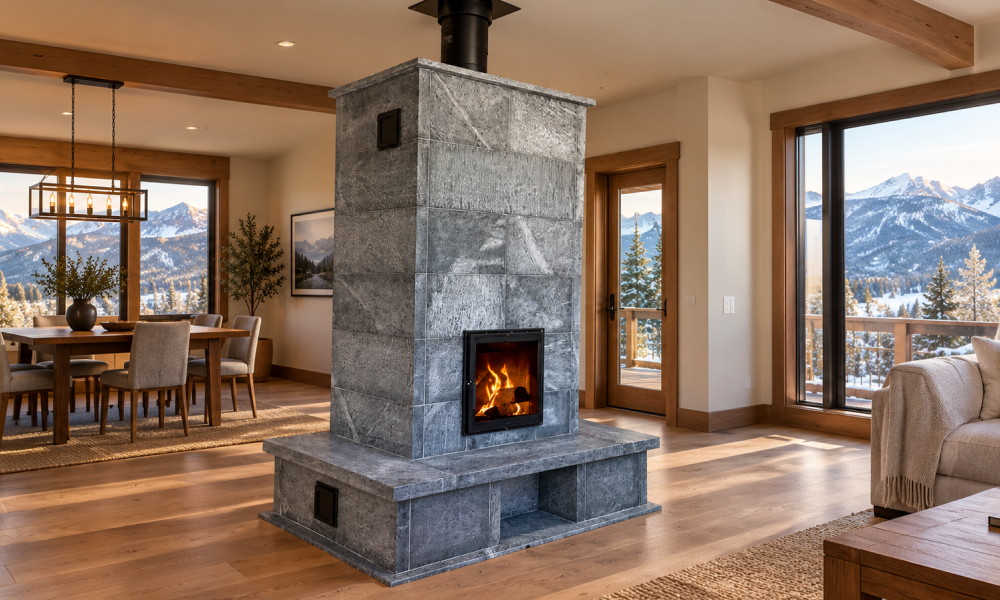
Heating a mountain home is not the same problem as heating a house in town, even if the thermostat on the wall looks identical. Altitude changes how efficiently some systems run. Winters hit harder and last longer.
Power lines that follow a mountain road are more exposed to the kind of storms that knock out electricity for days, not hours. And a lot of mountain homes sit empty for stretches at a time, which raises a whole separate question about freeze protection that a full-time in-town house never has to deal with.
This guide walks through the real options for heating a mountain home, honestly, including where each one falls short, so you can figure out which combination actually makes sense for your specific property.
What Makes Heating a Mountain Home Different
A few factors show up again and again for mountain properties specifically. Altitude affects combustion appliances and can change how some heating equipment performs compared to sea-level ratings. Winters are simply colder and longer than most heating systems are designed around by default.
Grid power is often less reliable the farther you get from town, and a downed line during a storm can mean days without electricity rather than a quick repair. And because many mountain homes are seasonal, weekend cabins, vacation rentals, or properties used only part of the year, freeze protection matters even when nobody is there to notice the thermostat has failed.
A well-insulated mountain home makes every option on this list perform better, so it is worth saying upfront: insulation and air sealing are not a separate topic from heating, they are the foundation everything else is built on. No heating system fully makes up for a home that is leaking heat through poor insulation and drafty windows.
Radiant Floor Heating for Mountain Homes
How In-Floor Hydronic Heat Works
Radiant floor heating, most commonly installed as hydronic in-floor heat, runs warm water through tubing installed beneath the floor, typically embedded in a concrete or gypsum-based underlayment.
A boiler heats the water, which then circulates through the home, warming the floor itself and radiating that heat upward into the room. Unlike forced air, there is no blowing air and no noticeable draft, just a warm floor and an evenly heated space.
Why It’s So Common in Modern Mountain Builds
This is genuinely one of the most popular heating choices in new mountain construction, and it is easy to see why once you have stood on a warm wood floor in bare feet during a January morning.
It heats evenly, avoids the dry, blown-air feeling of a forced air furnace, and pairs well with the kind of large windows and open floor plans common in mountain homes built around a view.
The tradeoff is cost. In-floor systems are considerably more expensive to install than most alternatives, and they are best planned during new construction or a major renovation rather than retrofitted into an existing home.
Heat Pumps: Efficient, But Not Always Built for the Mountains
Heat pumps get recommended constantly as an energy-efficient, dual-purpose heating and cooling solution, and in moderate climates, that reputation is well earned. In genuinely cold mountain climates, the story is more complicated.
Standard heat pumps lose capacity as outdoor temperatures drop, and the U.S. Department of Energy has documented that conventional heat pump systems can lose up to 60 percent of their heating capacity at cold outdoor temperatures around negative 13 degrees Fahrenheit, which is exactly the kind of cold snap a mountain property is likely to see at some point every winter.
This is not a fringe concern. It is significant enough that the Department of Energy launched a Cold Climate Heat Pump Technology Challenge specifically to push manufacturers toward better performance in these conditions, since standard heat pump technology simply was not holding up well in the coldest parts of the country.
Newer cold-climate-rated heat pump models perform considerably better than older standard units, but even the best of them are generally recommended as a strong supplemental system for a mountain home rather than the sole source of heat through the coldest stretch of winter.
Geothermal Heating for Mountain Properties
Geothermal systems draw heat from the relatively stable temperature underground, using a buried loop system connected to a heat pump inside the home.
Because the ground stays a consistent temperature well below the surface regardless of how cold the air gets, geothermal systems avoid the cold-weather performance drop-off that plagues standard air-source heat pumps.
The catch is upfront cost and site requirements. Installing the underground loop system involves significant excavation or drilling, which can be expensive and, depending on your property’s terrain, sometimes genuinely difficult on a rocky mountain lot.
For homeowners building new or willing to make the investment, geothermal offers strong, consistent efficiency. For a lot of mountain properties, the site conditions and upfront cost put it out of reach compared to other options on this list.
Freeze Protection for Unoccupied Mountain Homes
This is a genuinely different concern than day-to-day comfort heating, and it deserves its own attention if your mountain home sits empty for stretches at a time.
A frozen and burst pipe while nobody is home can cause serious damage well before anyone notices, and the systems best suited for daily comfort are not always the ones best suited for reliably preventing this while unattended.
Electric heat with a monitored, low-temperature setting is a common baseline for freeze protection, since it requires no one to physically manage anything as long as the power stays on.
The real vulnerability is exactly the power outage scenario covered elsewhere in this guide, an electric-only system offers zero protection the moment the grid goes down, which is precisely when a hard freeze is often happening outside.
Some mountain homeowners address this with a remote monitoring system that alerts them to temperature drops or power loss, paired with a battery backup for critical systems like water line heat tape.
Others lean on a propane system with battery backup for its ignition and controls, since propane itself does not require grid power once the system is running, only the electronics controlling it do.
For a genuinely storm-prone or remote property, this is one more argument in favor of having some kind of non-electric backup heat source available, even for a home that is not occupied full time, since a caretaker or neighbor checking in periodically can get a wood-burning system going during an extended outage in a way that no electric system allows for.
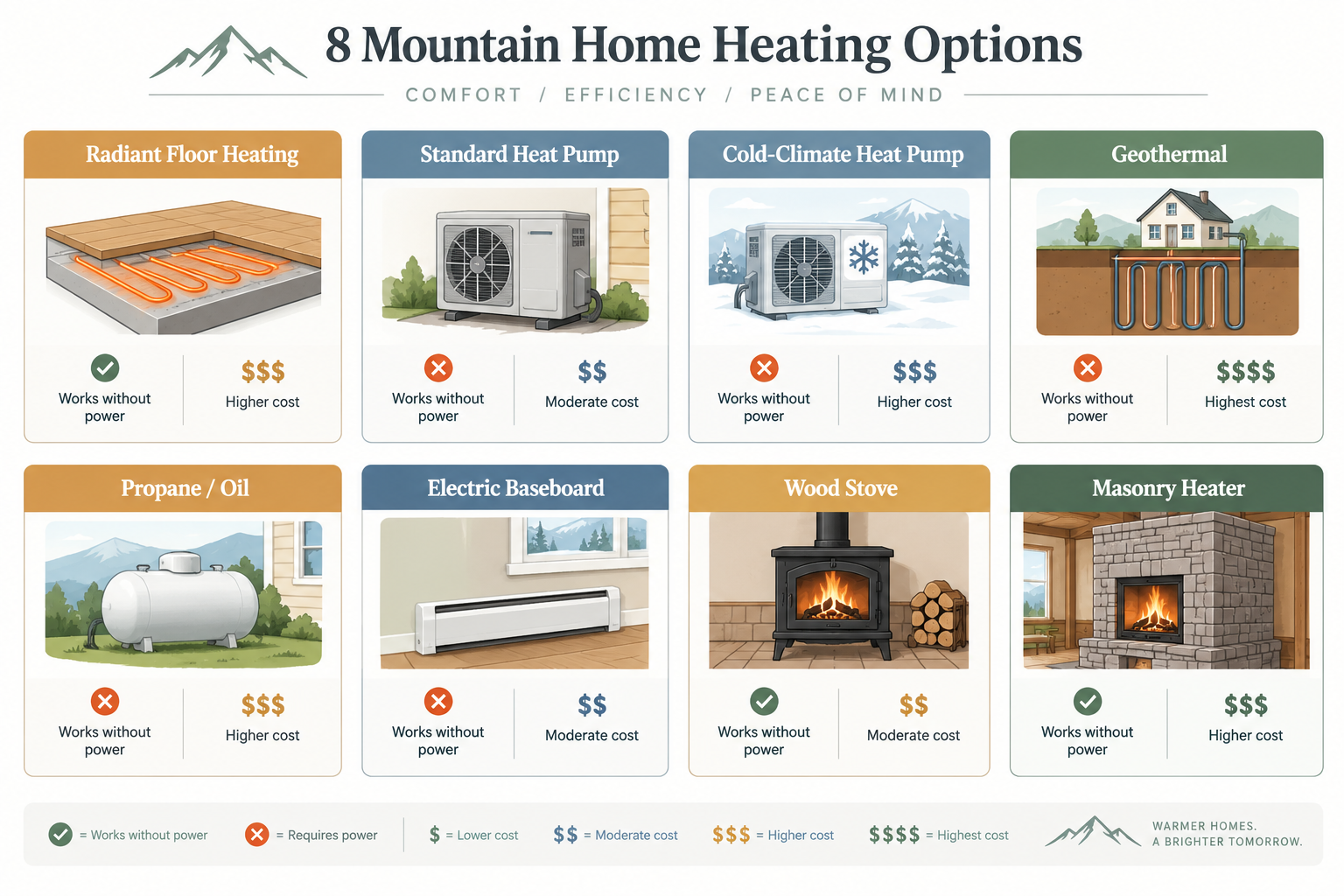
Cost Comparison at a Glance
Every mountain home is different, and exact numbers depend heavily on your specific property, but the general cost pattern across these options tends to hold fairly consistently.
| Heating Option | Relative Upfront Cost | Relative Ongoing Cost | Works Without Power |
| Radiant floor (hydronic) | High | Low to moderate | No |
| Standard heat pump | Moderate | Low to moderate | No |
| Cold-climate heat pump | Moderate to high | Low to moderate | No |
| Geothermal | Very high | Low | No |
| Propane or oil furnace | Moderate | Moderate to high | Partial (ignition/controls need power) |
| Electric baseboard | Low | High | No |
| Standard wood stove | Low to moderate | Low | Yes |
| Masonry heater | High | Very low | Yes |
The pattern worth noticing here is that the two options requiring zero electricity to operate, a standard wood stove and a masonry heater, sit at opposite ends of the upfront cost spectrum but share the lowest ongoing fuel costs and the only fully power-independent operation on the entire list.
Propane, Oil, and Electric Heat: The Convenient Standbys
Why These Remain Popular for Mountain Cabins
Propane, oil, and standard electric heat remain common choices for mountain cabins largely because of convenience.
A thermostat-controlled propane or oil furnace, or simple electric baseboard heaters, requires very little hands-on management. You set the temperature and the system handles the rest, which matters a lot for a property you are not at every day.
The Tradeoff: Fuel Delivery and Grid Dependency
The real tradeoff comes down to dependency. Propane and oil both require fuel deliveries, which can be genuinely difficult to schedule reliably during a hard winter on a remote mountain road, and running out of fuel during a cold snap risks frozen pipes in an unattended home
Electric heat depends entirely on grid power, which, as already mentioned, is often less reliable the farther a property sits from town. None of these options are unreasonable choices, but all three share the same underlying vulnerability: they depend on something arriving from outside the property, whether that is a fuel truck or a power line.
Wood Stoves and Masonry Heaters: Heat You Can Count On
Standard Wood Stove for a Mountain Home
A wood stove is a longtime staple of mountain heating for good reason. It requires no electricity, no fuel delivery beyond firewood you can often source locally, and it provides real, immediate warmth.
The tradeoff is that a standard wood stove burns hot and fast, then cools quickly, which means frequent reloading to maintain consistent heat, along with the ongoing work of managing a live fire throughout the day.
Masonry Heaters: The Wood-Burning Option Built for Serious Cold
A masonry heater takes the same wood-burning independence and solves the reloading problem directly.
Rather than burning continuously, a masonry heater is fired once or twice a day with a short, hot, fast fire, and its dense thermal mass absorbs and stores that heat, radiating it slowly back into the room for twelve to twenty four hours.
Well-designed masonry heaters commonly reach 85 to 95 percent combustion efficiency, a meaningful step up from a standard wood stove’s efficiency, and require no electricity at all to function.
For a mountain home specifically, that combination is hard to match. It needs no grid power and no fuel delivery truck making it up an icy road, it burns local firewood efficiently enough to meaningfully reduce how much wood you need to keep the house warm, and it delivers steady, even heat through a long, cold night rather than the up-and-down cycle of a standard stove.
Our full masonry heater vs wood stove comparison covers the differences between the two in more detail if a standard wood stove is also on your list.
For a broader look at how masonry heaters compare against other wood-burning and non-wood alternatives beyond just a standard stove, our guide to alternatives to wood stoves covers that wider comparison as well.
Off-Grid and Power Outage Reliability
This deserves its own section because it matters more for a mountain property than almost anywhere else. Storms that would cause a brief inconvenience in town can knock out power to a remote mountain line for days, and a home relying entirely on an electric furnace, heat pump, or even a propane system with an electric ignition and blower can go cold at exactly the moment heat matters most.
A backup heat source for a mountain home is not a luxury consideration, it is closely tied to protecting the property itself from frozen and burst pipes during exactly the kind of storm that also knocks out power.
Wood-burning options, a standard wood stove or a masonry heater, are the only entries on this list that require zero electricity to produce heat, which makes them a genuinely resilient backup even for homes that rely primarily on a different system day to day.
Many mountain homeowners land on a hybrid approach for exactly this reason: an efficient primary system like radiant floor heat or a cold-climate heat pump for daily convenience, paired with a wood-burning system as reliable backup for the storms that inevitably knock the grid out.
Passive Solar Design as a Supporting Strategy
No heating system operates in a vacuum, and passive solar design is worth mentioning even though it is not a heating system on its own.
Mountain homes often have the advantage of strong, direct winter sunlight, and thoughtful window placement, paired with good insulation and thermal mass inside the home, can meaningfully reduce how hard any heating system needs to work on a sunny winter day.
This is not a replacement for a real heating system, but it is a genuinely free assist that pairs well with any of the options above, and it is far easier to plan for during new construction than to retrofit later.
Which Option Is Right for Your Mountain Home?
Full-Time Residence in a Cold Climate
For a home you live in year-round through serious cold, prioritize both efficiency and reliability. Radiant floor heat or a cold-climate-rated heat pump as a primary system, paired with a masonry heater or wood stove as backup, covers both daily comfort and the reality of an eventual power outage.
Seasonal or Occasionally Occupied Cabin
For a cabin used part of the year, simplicity and freeze protection matter more than day-to-day efficiency optimization.
A reliable electric or propane system with a monitored thermostat, paired with a wood-burning backup for when you are actually there, is a practical combination for a property that sits empty for stretches at a time.
Off-Grid or Remote Property
For a genuinely off-grid or remote mountain property, wood heat moves from a nice-to-have backup to the most practical primary option on this entire list.
A masonry heater in particular delivers real efficiency and long-duration heat without asking anything of a power grid that may not even reach the property.
Frequently Asked Questions
What is the best way to heat a mountain cabin?
It depends on how the cabin is used. For occasional use, a simple, reliable system like propane or electric heat with a wood-burning backup works well. For full-time or off-grid use, wood heat, particularly an efficient masonry heater, becomes a much stronger primary option.
Do heat pumps work in cold mountain climates?
Standard heat pumps lose significant capacity in very cold temperatures and are generally better suited as a supplemental system in genuinely cold mountain climates. Newer cold-climate-rated heat pump models perform better but are still often paired with a backup heat source for the coldest stretches of winter.
What heating system works best off-grid?
Wood-burning systems, especially a masonry heater, are the most practical primary heat source for a true off-grid property, since they require no electricity at all to produce and store heat.
How do you heat a mountain home during a power outage?
A wood-burning system, whether a standard wood stove or a masonry heater, is the only heating option on this list that continues working through a power outage with zero electrical input, making it the most reliable outage backup for a mountain property.
Is wood heat better than electric in the mountains?
It depends on the goal. Electric heat offers convenience and simplicity when the grid is reliable, while wood heat, particularly a masonry heater, offers efficiency and independence from the grid entirely, which matters more the more remote or storm-exposed the property is.
Not Sure Which Combination Makes Sense for Your Home?
Most mountain homes end up with more than one heating strategy working together rather than a single perfect answer, and figuring out that combination depends heavily on your specific property, how it is used, and how exposed it is to power outages.
If a wood-burning system, especially a masonry heater built for serious cold and long-duration heat, is turning out to be the right fit for your situation, book a consultation with Greenstone Masonry Heaters. We can walk you through what that would actually look like for your home.