

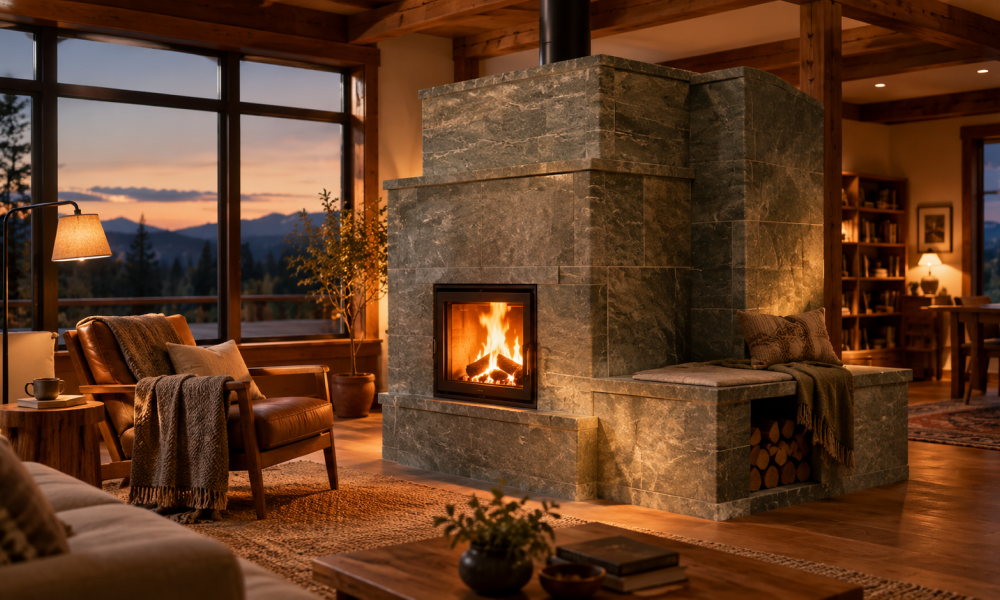
If you’ve spent any time researching masonry heaters, you’ve probably noticed something frustrating. Ask three different builders which material is best, and you’ll get three different answers.
One swears by soapstone. Another has spent thirty years working with brick and won’t hear otherwise. A third points you toward a European-style tiled Kachelofen and calls it the only “real” option.
They’re not lying to you. They’re each optimizing for something different. Heat retention, upfront cost, aesthetics, and regional building tradition all pull in slightly different directions. So instead of picking a side, let’s walk through what each material actually does, where it shines, and where it falls short, so you can match the material to your home instead of someone else’s opinion.
What Is a Masonry Heater, and Why Does Material Matter?
A masonry heater isn’t a fireplace, and it isn’t a wood stove, even though people lump all three together.
The design is deceptively simple, and it comes in a handful of distinct types of masonry heaters before you even get to the material question. But at its core, a small, efficient firebox burns wood hot and fast, and instead of sending that heat straight up the chimney, the exhaust gets routed through a maze of internal channels built into a dense mass of material.
That mass soaks up the heat like a battery, then releases it slowly, often over 12 to 24 hours, as steady radiant warmth instead of the hot-cold cycling you get from a stove.
This is where material choice stops being cosmetic. The mass isn’t decoration, it’s the engine. How dense the material is, how well it conducts heat into its core, and how evenly it releases that heat back into the room all come down to what the mass is made of.
That’s the real difference between radiant heat and the convection heat most furnaces and stoves produce, and it’s worth understanding why radiant heat feels so different room to room before you commit to a material.
Soapstone Masonry Heaters
Soapstone gets talked about like it’s a luxury add-on, but the appeal isn’t really about looks. It’s physics. Soapstone conducts heat faster than brick or standard tile, which means it pulls warmth out of the firebox core more efficiently during the burn.
At the same time, it has a genuinely high heat capacity, so it doesn’t just grab heat quickly, it holds a lot of it.
Soapstone Heat Retention and Conductivity
Here’s the part that surprises people: soapstone’s higher conductivity doesn’t mean it dumps heat faster into the room. It means the stone itself heats through more evenly and completely during a burn, so by the time the fire’s out, more of the mass is actually warm, not just the inner core.
That translates into longer, steadier radiant output on the surface, often stretching heat release well past the 12-hour mark on a properly sized unit. The exact numbers depend on stone thickness, chamber design, and how the heater is sized to the space, which is why real soapstone thermal performance data matters more than marketing claims.
Soapstone Masonry Heater Pros and Cons
The upside is straightforward: excellent, even heat output, a smoother surface finish, and a stone that naturally comes in warm grays and greens a lot of homeowners find easier to work into modern interiors than raw brick. It’s also lower maintenance in the sense that soapstone doesn’t crack from thermal shock the way some materials can under repeated heating and cooling cycles.
The downside is cost. Soapstone is quarried in limited locations, Greenstone’s stone comes from Brazil and India, and it’s simply a pricier raw material than local brick or standard tile.
You’re also somewhat limited on exterior texture compared to brick or veneer, though most manufacturers now offer soapstone cores wrapped in stone or brick veneer if you want the performance without the all-soapstone look.
Brick Masonry Heaters
Brick is the material most people picture when they hear “masonry heater,” and for good reason. It’s the traditional build across much of Northern and Eastern Europe, and it’s what most first-generation American masonry heaters were built from during the 1970s and 80s revival.
How Brick Compares for Thermal Mass Heating
Brick has real thermal mass, but it conducts heat more slowly than soapstone, which changes the character of the heat you get. A brick heater takes longer to warm through during a burn, and it releases heat a bit more gradually at a lower surface temperature.
Some homeowners actually prefer this, a gentler, more even background warmth rather than a stone that gets noticeably hot to the touch near the firebox. The tradeoff is that brick generally needs more total mass to store the same amount of heat as soapstone, which is part of why traditional brick heaters tend to be physically larger.
Brick Masonry Heater Pros and Cons
Cost is brick’s biggest advantage. It’s widely available, well understood by masons across the country, and typically the most budget-friendly core material. It’s also incredibly durable. A well-built brick heater core can genuinely outlast the house around it.
The tradeoffs: brick is heavier per unit of heat storage, meaning larger footprints and more attention to foundation support. It’s also less forgiving of poor design. A soapstone heater with slightly imperfect flue geometry still performs reasonably well because the stone compensates. A brick heater with poor channel design underperforms more noticeably. Foundation planning isn’t optional here, it’s worth reviewing foundation and structural support requirements early if brick is on your shortlist, since the weight load is a real design constraint.
Tile Masonry Heaters (Kachelofen Style)
Tile-clad heaters, known in German-speaking Europe as Kachelofen, are the oldest continuously built masonry heater style still in production, dating back centuries in Austria, Germany, and Switzerland.
Rather than being a structural material like brick or soapstone, tile in these designs typically wraps a core built from firebrick or refractory material, with the glazed ceramic tile forming both the exterior surface and, in traditional builds, an additional insulating air gap.
Tile Stove vs Soapstone Heater: Key Differences
The biggest functional difference is that tile itself isn’t usually the primary thermal mass, the core underneath is. That air gap between tile and core actually slows heat transfer to the surface, which means tile stoves tend to run a lower, more comfortable surface temperature over a longer period compared to a solid soapstone exterior, which gets warmer to the touch faster.
According to Wikipedia’s overview of the technology, masonry heaters covered in tile are specifically categorized as Kachelofen, a design tradition with roots stretching back to the Neolithic period, so the tile approach to radiant heat isn’t a novelty. It’s arguably the most tested design lineage there is.
Tile Masonry Heater Pros and Cons
Tile’s biggest strength is customization. Glazed tile comes in essentially unlimited colors and patterns, and traditional Kachelofen craftsmanship can produce genuinely ornate, furniture-grade pieces. It’s also gentle on the skin-contact safety front, since surface temps stay moderate.
The downside is sourcing and labor. True Kachelofen construction is a specialized craft, and finding installers in North America who build to that tradition is harder than finding a soapstone or brick mason.
Tile is also more prone to hairline cracking at glaze joints over decades of thermal cycling than a monolithic soapstone slab.
Soapstone vs Brick vs Tile: Head-to-Head Comparison
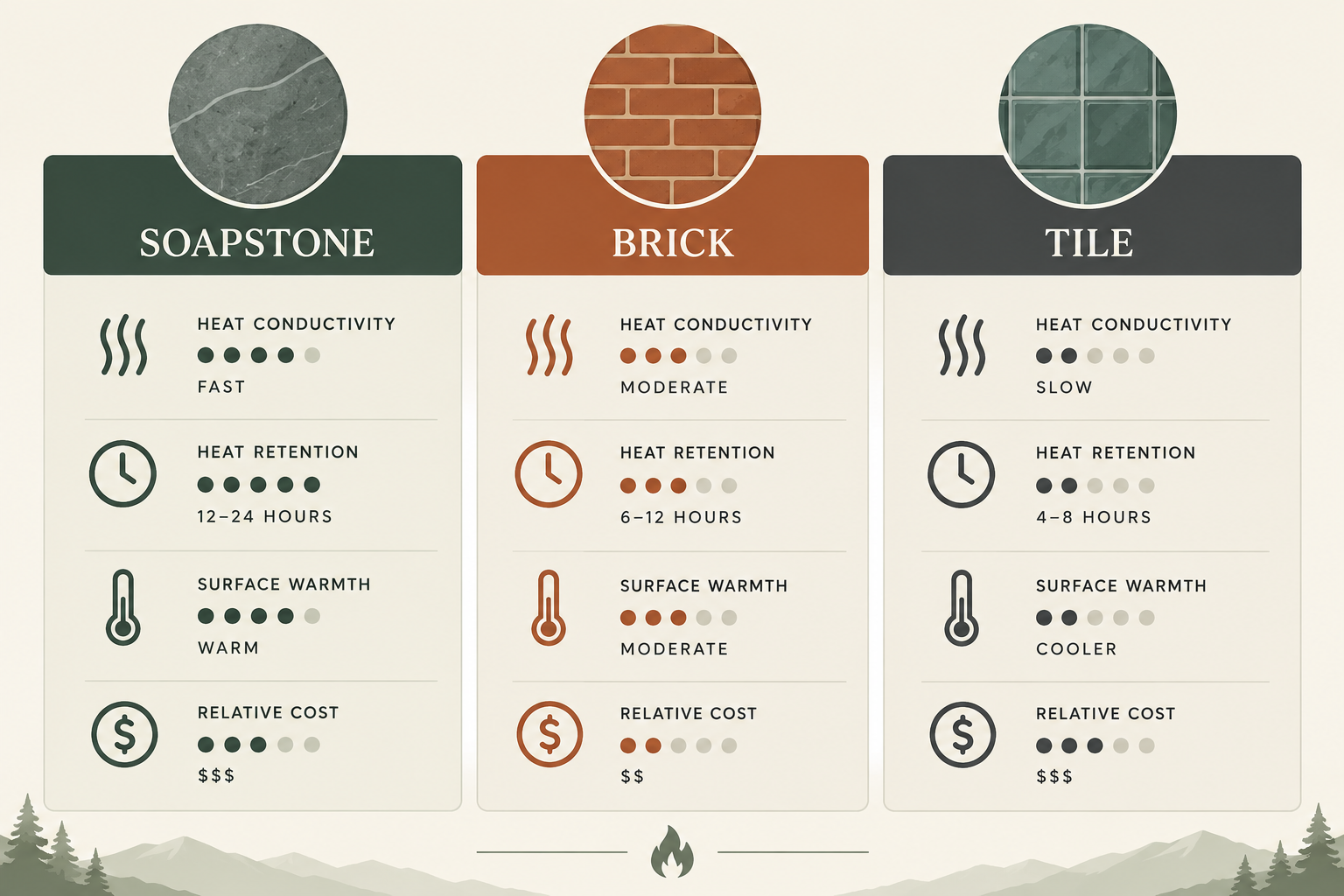
| Factor | Soapstone | Brick | Tile (Kachelofen style) |
| Heat conductivity | High, warms through fast | Moderate, slower to heat | Low at surface (insulating air gap) |
| Heat retention | Excellent, long even release | Good, gentler release | Good, very steady low-temp release |
| Surface feel | Warms noticeably | Moderate warmth | Coolest to the touch |
| Typical footprint | Compact for output | Larger for equivalent mass | Moderate, core dependent |
| Customization | Stone tone, some veneer options | Wide veneer/finish range | Nearly unlimited tile patterns |
| Relative cost | Highest | Most affordable | Mid to high, labor driven |
| U.S. installer availability | Growing, specialty trade | Widely available | Limited, specialty trade |
Which Heats a Room Faster: Soapstone, Brick, or Tile?
Soapstone wins this one, plainly. Its higher conductivity means the stone reaches usable radiant temperature sooner into the burn cycle than brick, and considerably sooner than a tile-clad core with an insulating air gap. If you want faster warm-up on a cold morning, soapstone has the physics on its side.
Which Material Lasts Longest?
Honestly, all three can last generations if built correctly. Masonry heaters aren’t disposable appliances. Brick has the longest documented track record simply because it’s been used the longest in volume. But soapstone’s resistance to thermal shock cracking gives it a practical edge in heaters that get burned hard, daily, for decades.
Tile’s weak point tends to be the glaze and joint seams, not the underlying core, so a tile heater’s lifespan often comes down to installation quality more than the material itself.
Masonry Heater Cost Comparison by Material
Rough numbers here, since exact pricing always depends on design complexity, bake ovens, and regional labor. Brick core heaters tend to sit at the lower end of the masonry heater price range, soapstone runs meaningfully higher due to raw material cost, and tile lands somewhere in between to above soapstone depending on how ornate the tilework is and how specialized the installer needs to be.
For a fuller breakdown of what drives these numbers, our guide to masonry heater cost walks through pricing by build type in more detail.
Complicating the “which is cheapest” question is that these heaters are almost always custom sized to the home, not off the shelf. A heater sized too small won’t hold enough mass to carry the home through the night. Oversized, and you’ll overheat the space.
That’s why proper heater sizing, based on square footage, climate, and insulation, matters more to your final cost than the material line item alone.
Which Masonry Heater Material Is Best for Cold Climates?
If you’re in a genuinely cold climate, think northern New England, the Mountain West, interior Alaska, soapstone’s faster heat-up and higher total heat capacity tend to be the more practical fit for homes that need serious sustained output through long winters. Brick still works fine in cold climates, it just may need a larger footprint to deliver comparable output.
Tile shines less on raw output and more on comfort. That gentler, cooler-to-the-touch surface is genuinely pleasant in a home where the heater runs almost constantly through a long season, even if it’s not the fastest to respond to a sudden cold snap.
None of this happens by accident, either. The U.S. EPA has noted that fireplaces and masonry heaters currently fall outside its wood heater certification program, unlike the pellet stoves covered in our masonry heater vs pellet stove comparison, which is exactly why the internal engineering, chamber design, mass, and material matter so much. There’s no regulatory floor forcing efficiency here. The design has to earn it.
Frequently Asked Questions
Is soapstone better than brick for a heater?
It depends what you’re optimizing for. Soapstone heats faster and holds more heat per volume, which usually means better performance in a smaller footprint. Brick is more budget friendly and has an equally long track record. It’s not “worse,” it just behaves differently.
Why is soapstone used in masonry heaters?
Mainly its combination of high heat capacity and relatively high thermal conductivity, a rare pairing. Most dense materials are good at one or the other, not both.
Does brick or soapstone heat a room faster?
Soapstone, generally, because it conducts heat into its mass more quickly during the burn.
Can you combine materials, like a soapstone core with a brick or veneer exterior?
Yes, and it’s increasingly common. Manufacturers offer soapstone or firebrick cores skinned in stone, ledgestone, or brick veneer, which lets you get soapstone’s thermal performance with a different exterior look.
Ready to Choose the Right Material for Your Home?
Reading about soapstone, brick, and tile only gets you so far. The right choice really comes down to your climate, your home’s layout, and how you want the finished heater to look and feel in the room. Greenstone Masonry Heaters has been building custom masonry heaters in soapstone, brick core, and veneer finishes since 2008, and can walk you through what actually makes sense for your specific space.