

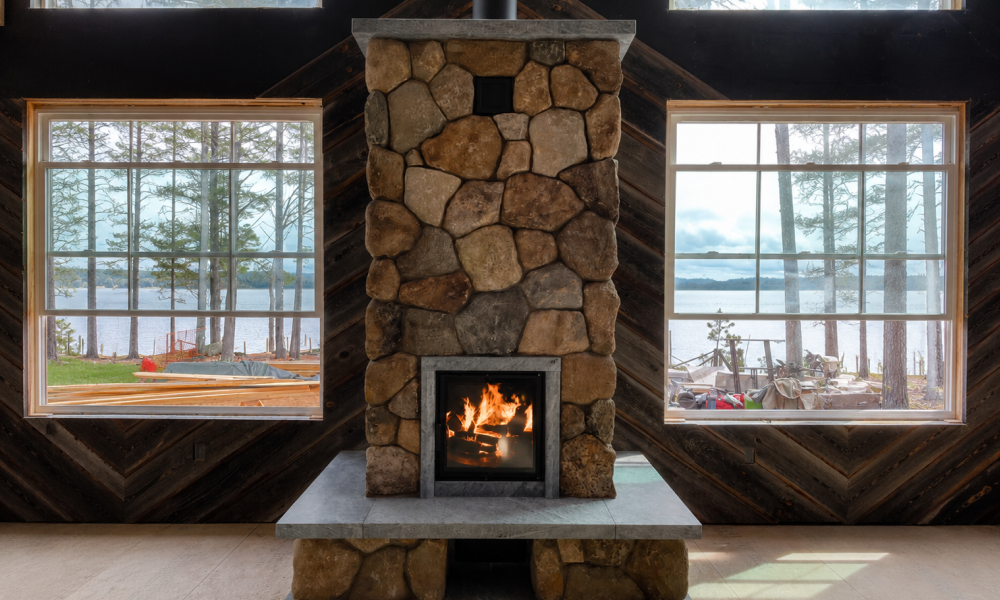
Say “masonry heater” to most people and they picture one thing: a big stone mass that somehow stays warm for hours after the fire’s out. Fair enough, that’s the general idea. But it’s really an umbrella term covering a handful of genuinely different designs, some built around narrow winding channels, others around one big open chamber, each with its own history and its own reason for existing. Pick the wrong one for your home and climate, and you’ll end up disappointed even though “a masonry heater” was technically the right call.
So this guide walks through the main types you’ll actually run into: contraflow, bell-style, Kachelofen, Grundofen, Russian, and Finnish designs, how their internals differ, and which ones tend to make sense for which kind of home.
What Makes a Masonry Heater a “Type”?
Every masonry heater shares the same core idea. A hot, fast fire burns in a firebox, and the heat and gases are drawn through the surrounding masonry before they exit through the chimney. That masonry absorbs the heat and slowly radiates it into the room for hours after the fire is out. Most masonry heaters are fired once or twice a day, burning somewhere between ten and twenty five kilograms of wood per session, then radiate that stored heat for twelve to twenty four hours depending on the design and how much mass it holds.
What changes between types is the internal path that smoke and heat travel, along with the materials and shape used to build it. Some designs favor long, winding channels. Others use large open chambers. These design choices affect how quickly a heater warms up, how evenly it distributes heat, how hot the outer surface gets, and how it looks in a room. Surface temperatures vary quite a bit by design too, ranging from around 100 degrees Fahrenheit on heavier units built for a full 24 hour heat cycle, up to roughly 180 degrees Fahrenheit on lighter units designed for a shorter 8 to 12 hour cycle.
Main Types of Masonry Heaters
Contraflow Masonry Heaters
The contraflow design is the most common type built today. Heat and smoke rise from the firebox, travel up through a central channel, then get pulled back down through a second set of channels along the outside before reaching the chimney. This up-and-down path forces the gases to give up more of their heat to the surrounding masonry before they escape.
The design traces back to Scandinavia, where it was refined before spreading to the Baltic region, and it later gained real traction in North America during the 1980s largely through Finnish influence. Because of how effectively it extracts heat, the contraflow is often the design people mean by default when they talk about a modern masonry heater.
Bell-Style Masonry Heaters
A bell-style heater uses a different approach entirely. Instead of narrow channels, hot gases rise into a large open chamber, or bell, where they slow down and release heat before naturally sinking and exiting near the bottom. This free-flowing gas movement, rather than a fixed channel path, is what sets bell heaters apart from a contraflow design.
The bell heater originated in Russia before spreading across Europe and, more recently, gaining popularity in the US and Canada. Because the gas movement inside a bell heater isn’t locked into a rigid channel system, this design tends to be simpler to build, distributes heat a bit more evenly across a larger thermal mass, and offers more flexibility for multi-story installations than a contraflow heater typically allows.
Kachelofen
The Kachelofen, or tile stove, originated in the European Alps and remains especially common in German-speaking countries and parts of Eastern Europe, where it has historically been used for both heating and cooking. Beyond the tile finish, a Kachelofen typically uses a similarly winding internal channel system to a contraflow heater, but the glazed tile surface, either factory produced or hand made by a pottery specialist, adds a decorative element that has made this style popular for centuries.
Grundofen
A Grundofen is closely related to the Kachelofen but skips the ceramic tile in favor of refractory masonry materials for its facing, giving it a more understated, stone-like appearance. Because these refractory materials store heat less efficiently than soapstone, roughly a sixth as effectively pound for pound, a Grundofen typically needs a longer internal gas path and a larger overall structure to extract the same amount of heat, with some builds weighing well over 1,500 kilograms.
That size comes with a tradeoff in timing. A Grundofen can take several hours to begin radiating noticeable warmth after it is lit, but once it does, a single load of roughly 20 kilograms of wood can keep it radiating steadily for a full day and night. The outer walls also stay relatively cool, rarely climbing past about 130 degrees Fahrenheit, which is part of why Grundofen stoves are still hand built by the hundreds every year in southern Germany, often finished with decorative tile or plaster since the surface never gets hot enough to damage those materials.
Russian Fireplaces
Despite the name, a Russian fireplace, sometimes just called a Russian stove, was used throughout much of Europe, not only Russia. This design tends to be larger and was historically built to do more than just heat a room. Many included a sleeping platform or bench built directly into the warm masonry, and some doubled as a cooking oven.
Finnish Stoves
The Finnish stove is a more compact take on the masonry heater, developed for Nordic climates where efficient, fast heating mattered in a smaller footprint. These heaters commonly use soapstone rather than brick, since soapstone stores more heat per pound and responds quickly to a fire. If you want to dig deeper into why that material choice matters, this guide on why soapstone is the ultimate material for masonry heaters breaks down the science behind it.
Custom vs. Modular Masonry Heaters
Custom-Built Masonry Heaters
A custom masonry heater is designed and built on-site to fit the exact dimensions, layout, and aesthetic of a specific home. This route offers the most flexibility, letting you choose the internal design, finish material, and overall shape, but it also takes more time and a skilled mason to build correctly.
Modular or Kit Masonry Heaters
A modular, or kit, masonry heater uses pre-engineered components that are assembled on-site rather than built entirely from scratch. This can shorten construction time and reduce some of the variability that comes with a fully custom build, though it typically offers fewer options for size and layout compared to a custom design.
How Design Affects Heat Output and Efficiency
The internal design of a masonry heater has a direct effect on how efficiently it burns fuel and how it releases heat. Longer, more winding channel systems, like those in a contraflow design, tend to extract more heat from each fire before the gases escape, which is part of why well-designed masonry heaters can reach combustion efficiency levels far above a standard fireplace. Design also affects how quickly a room actually starts to feel warm, and some masonry heaters achieve it better than others depending on firebox size and channel layout. For a closer look at how this plays out in real numbers, this breakdown of masonry heater efficiency and combustion rates covers exactly how that performance is achieved.
Materials Used Across Types
While internal design determines the heat path, the material used for the mass itself affects how much heat is stored and how quickly it releases. Brick is the traditional choice and remains common in Kachelofen and Russian-style heaters. Soapstone, favored in many Finnish stoves and increasingly in modern custom builds, stores more heat per pound than brick and begins radiating warmth faster after a fire starts. Tile is often used as a decorative outer layer rather than the core thermal mass itself.
Which Type of Masonry Heater Is Best for You?
Best for Cold Climates and Daily Use
If you live somewhere with long, cold winters and plan to fire your heater daily, a contraflow or Finnish-style soapstone heater is usually the strongest choice, since both are built specifically to maximize heat extraction from each fire.
Best for Smaller Homes or Space Constraints
A Finnish stove’s compact footprint makes it a natural fit for smaller homes where floor space is limited but you still want serious heating performance.
Best for Aesthetic-First Buyers
If the visual centerpiece matters as much as the heat output, a Kachelofen’s tiled finish or a custom-built heater with a decorative stone facade tends to be the better fit.
Best for Whole-House Heating
For larger homes or open floor plans, a Russian-style or larger custom contraflow heater, sized correctly for the space, can radiate enough heat to warm multiple rooms from a single fire. Getting the size right matters here more than the type itself, so it is worth reviewing a proper masonry heater sizing guide before settling on a design.
Frequently Asked Questions
What are the different types of masonry heaters?
The main types include contraflow heaters, bell-style heaters, Kachelofen tile stoves, Grundofen stoves, Russian fireplaces, and Finnish stoves, along with the choice between a custom-built or modular design.
Which type of masonry heater is best for my home?
It depends on your climate, available space, and priorities. Contraflow and Finnish stoves tend to suit cold climates and daily use, while Kachelofen and custom designs are often chosen for their appearance.
What is a contraflow masonry heater?
A contraflow masonry heater channels heat and smoke up through a central path and back down through outer channels before reaching the chimney, which helps extract more heat from each fire.
What is the difference between a bell heater and a contraflow heater?
A bell heater uses one large open chamber to slow and release heat, while a contraflow heater relies on a narrower, winding channel system. Both aim to extract heat before it escapes, just through different internal shapes.
Are custom masonry heaters better than kit heaters?
Custom heaters offer more flexibility in size, layout, and finish, while kit or modular heaters can be faster and somewhat more predictable to install. Neither is universally better, it comes down to your home and priorities.
Final Thoughts
There is no single best masonry heater design, only the one that fits your climate, your space, and what you want out of it. According to background on the technology compiled on Wikipedia’s masonry heater overview, these designs have developed independently across cultures for thousands of years, and that long history is part of why so many distinct types exist today. Understanding the differences between contraflow, bell-style, Kachelofen, Grundofen, Russian, and Finnish designs is the first real step toward choosing the right one.
Want to Know Which Type of Masonry Heater Is Right for You?
Picking a type on paper is one thing. Living with it for the next thirty winters is another. The design that looks best in a photo is not always the one that fits your climate, your floor plan, or the way you actually move through your home during a cold snap. A contraflow might be the obvious choice for a house that gets fired daily, but if space is tight or the room is small, a Finnish stove could end up serving you better. Talk it through with someone who has actually built a few of these.
The team at Greenstone Masonry Heaters has spent years working through exactly this kind of decision with homeowners, so tell them your climate, your square footage, and how you picture using it, and let us help you land on the type that fits your life instead of just the one that fits the brochure.