

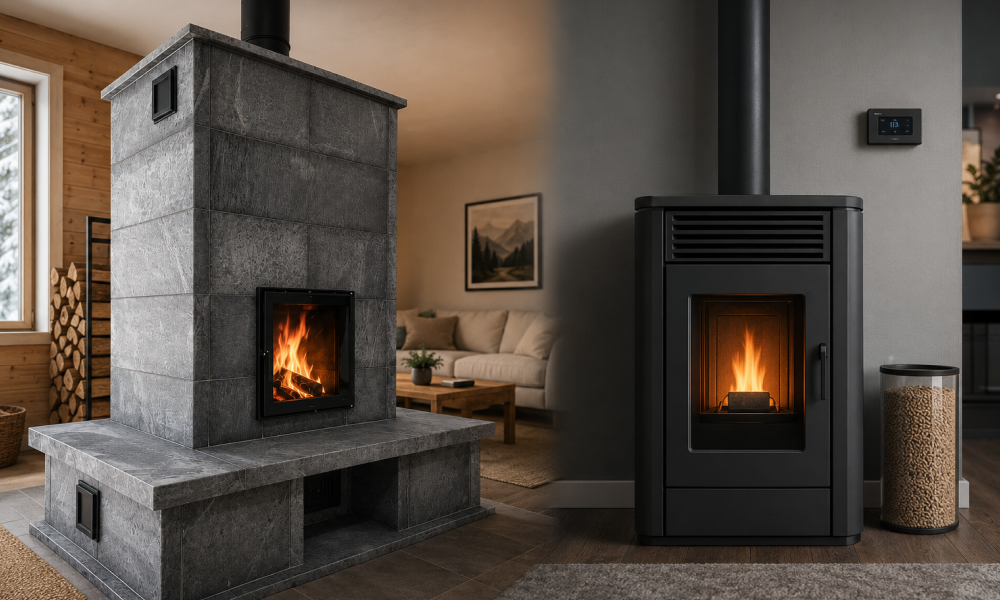
Both a masonry heater and a pellet stove get marketed as the smart, clean way to heat with wood. But they solve genuinely different problems. One is built around raw heating performance and long-term thermal storage. The other is built around convenience, automation, and not having to think about fire management at all. Understanding that difference matters more than any single spec sheet when you are deciding where to put your money.
In this guide, you will learn how a masonry heater and a pellet stove actually compare on efficiency, cost, reliability, and day-to-day convenience, so you can figure out which one is the smarter investment for your home.
What Is a Masonry Heater?
A masonry heater is a wood burning heating system built from dense, heat storing material like soapstone, brick, or refractory concrete. Rather than burning continuously, it is typically fired once or twice a day with a small, hot, fast fire. The surrounding masonry absorbs that heat through a winding internal channel system, then radiates it slowly into the room for twelve to twenty four hours. If you want a deeper breakdown of how this works, our guide to what a masonry heater is covers the fundamentals.
What Is a Pellet Stove?
A pellet stove is a very different kind of appliance. It burns small, compressed wood pellets that are automatically fed into the firebox by an electric auger, and a fan controls airflow and heat distribution. The U.S. Department of Energy’s guide to wood and pellet heating offers a useful overview of how these systems are regulated and rated for efficiency. Instead of managing a fire by hand, you set a thermostat and the stove handles feeding itself. This automation is the entire selling point of a pellet stove. It trades the intense, hands-on burn cycle of a masonry heater for a hands-off, appliance-like experience that behaves more like a furnace than a traditional wood fire.
How They Work: Key Differences
Masonry Heater Burn Cycle
A masonry heater is built around a short, intense burn. Wood is loaded once or twice a day, and the fire burns hot and fast, often reaching firebox temperatures well over 1,200 degrees Fahrenheit. At that temperature, most of the gases that would otherwise escape as smoke get burned off in a secondary combustion process before they ever reach the flue. The heat generated is absorbed into the masonry mass, then released slowly over the following hours.
Pellet Stove Burn Cycle
A pellet stove works more like a small furnace. Pellets feed into the firebox continuously in small amounts, keeping a steady, moderate flame going for as long as the stove is set to run. There is no single intense burn and no large thermal mass storing heat for later. Instead, heat output is roughly matched to what the room needs in real time, which is convenient but fundamentally different from the batch-and-store approach of a masonry heater.
Efficiency and Emissions Compared
Masonry Heater Efficiency and Emissions
Masonry heaters are known for extracting an unusually high percentage of usable heat from each fire, often in the range of 85 to 95 percent combustion efficiency. Because the fire burns so hot and completely, emissions are also very low. For a closer look at exactly how that efficiency is achieved, this breakdown of masonry heater efficiency and combustion rates covers the numbers in more detail.
Pellet Stove Efficiency and Emissions
Pellet stoves are also genuinely clean and efficient appliances, and this is worth being honest about rather than dismissing. Modern EPA-certified pellet stoves burn efficiently enough that their emissions levels land in a similar range to masonry heaters, which puts them well ahead of a standard fireplace or an older wood stove. The real differentiator between the two systems is not really efficiency on paper. It comes down to how each one delivers and stores that heat, and what that means for your day-to-day experience and reliability.
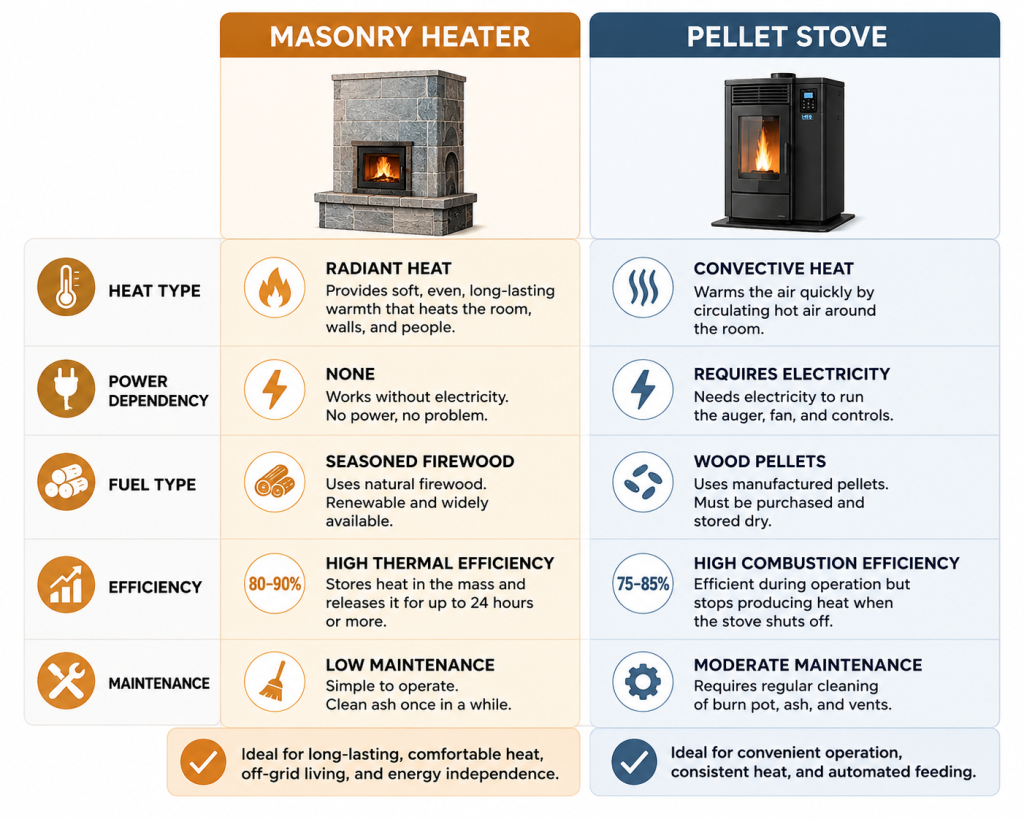
Masonry Heater vs Pellet Stove: Side-by-Side Comparison
| Feature | Masonry Heater | Pellet Stove |
| Heat type | Radiant, stored and released slowly | Forced air, delivered continuously |
| Power dependency | None, works without electricity | Requires electricity to run auger and fan |
| Fuel type | Cordwood | Compressed wood pellets |
| Burn cycle | One or two intense fires per day | Continuous, automated feeding |
| Efficiency | 85 to 95 percent | High, comparable emissions to masonry heaters |
| Maintenance | Minimal, occasional chimney inspection | Regular hopper refilling, auger and fan upkeep |
| Upfront cost | Higher | Lower |
| Lifespan | Decades, sometimes generations | Typically 10 to 20 years before major component replacement |
If you are also weighing a standard wood stove in this decision, our comparison of masonry heater vs wood stove covers that angle as well.
Power Outage Reliability
This is one of the most overlooked differences between the two systems, and it deserves its own spotlight. A masonry heater needs nothing but wood and a match. There is no electrical component required to light it, run it, or keep it producing heat. A pellet stove, on the other hand, depends entirely on electricity to run its auger and fan. If the power goes out, a pellet stove stops feeding fuel and stops heating your home, right when you may need it most.
For anyone in a region with frequent winter storms or unreliable grid power, this single factor can outweigh almost everything else on the comparison list.
Cost Comparison
Pellet Stove Cost
A pellet stove generally has a lower upfront cost than a masonry heater, and installation is typically simpler since it does not require the structural planning a masonry heater’s weight demands. However, ongoing fuel costs add up, since bagged wood pellets must be purchased regularly rather than gathered or sourced locally the way firewood often can be.
Masonry Heater Cost
A masonry heater represents a larger upfront investment, particularly for a custom-built unit, and its weight can require additional structural support during installation. That said, its fuel efficiency and use of cordwood, which is often cheaper or free compared to bagged pellets, can lead to meaningful long-term savings. Our breakdown of masonry heater ROI walks through how that payback period typically plays out.
Long-Term Value Over a Decade or More
Looking beyond the first year or two changes the math considerably. A pellet stove’s lower upfront cost is attractive, but ongoing pellet purchases and eventual auger or fan replacement add up over a decade of use. A masonry heater costs more to install but has essentially no moving parts to wear out and can remain fully functional for generations with only basic upkeep.
Maintenance: What Ongoing Upkeep Actually Looks Like
Cost comparisons often stop at the price tag, but day-to-day maintenance is where the two systems really start to feel different, and it is worth walking through in more detail.
Masonry Heater Maintenance
A masonry heater is mechanically simple. There is no auger, no fan, and no electronic control board that can fail. Ongoing upkeep mostly comes down to periodic chimney inspection, occasional cleaning of the ash pit, and checking the firebox and channel system for any signs of wear over the years.
Because there are so few moving parts, there is also very little that can break in the way a mechanical or electrical appliance can. Most owners find that once a season, or at most twice, is enough to keep a masonry heater running the way it should for decades.
Pellet Stove Maintenance
A pellet stove asks for more regular attention. The hopper needs to be refilled with bags of pellets on an ongoing basis, and the burn pot, glass, and ash tray typically need cleaning every one to two weeks during heating season to keep the stove burning efficiently.
Beyond routine cleaning, the auger motor, igniter, and circulation fan are all mechanical or electrical components that can wear out or fail over time, usually requiring a service call or replacement part. None of this is unreasonable for an automated appliance, but it does mean a pellet stove asks for a different kind of ongoing involvement than a masonry heater does.
What This Means Over Time
If you want an appliance you can largely forget about between inspections, a masonry heater’s simplicity is a real advantage. If you would rather trade a bit of routine upkeep for the convenience of automated, thermostat-controlled heat, a pellet stove’s maintenance demands are a fair price to pay for that convenience. Neither approach is wrong, it just depends on how hands-on you want your relationship with your heating system to be.
Environmental Impact: Which Is the Greener Choice?
Both systems get marketed as environmentally friendly alternatives to a standard fireplace, and both genuinely earn that label compared to older, less efficient wood burning options. But the way each one gets there is a little different, and it is worth understanding before assuming one is automatically the greener pick.
Masonry Heater Environmental Impact
A masonry heater’s environmental case rests almost entirely on combustion efficiency. Because the fire burns so hot and completely, very little unburned fuel escapes as smoke or particulate matter, and the wood itself is often sourced locally, sometimes even from a homeowner’s own property, which cuts down on the transportation footprint tied to fuel delivery. There is also no manufactured fuel product involved, no bagging, processing, or trucking of pellets, just cordwood burned as efficiently as a wood fire reasonably can be.
Pellet Stove Environmental Impact
Pellet stoves have their own environmental story worth crediting. Wood pellets are typically manufactured from sawdust and other wood waste that would otherwise be discarded, which means the fuel itself is often a byproduct of other lumber and forestry processes rather than freshly harvested wood.
That said, manufacturing, bagging, and transporting pellets does add an energy cost that cordwood generally avoids, and running the auger and fan also means a pellet stove has an ongoing electricity draw that a masonry heater simply does not.
The Honest Comparison
Neither system is clearly the more sustainable choice in every scenario. A masonry heater tends to have a smaller footprint if you have reasonable access to local firewood, while a pellet stove’s use of waste wood byproduct is a genuine point in its favor if pellets are sourced responsibly. Where a masonry heater pulls ahead more consistently is in total energy independence, since it requires no manufactured fuel supply chain and no electricity to operate at all.
Pros and Cons of Each
Masonry Heater Pros and Cons
Masonry heaters offer excellent efficiency, hours of radiant warmth from a single fire, zero dependency on electricity, and remarkable longevity. The tradeoffs are a higher upfront cost, significant weight requiring structural planning, and the need to manage a fire once or twice a day rather than simply setting a thermostat.
Pellet Stove Pros and Cons
Pellet stoves offer genuine convenience, automated operation, and a lower upfront cost. On the downside, they depend entirely on electricity to function, require regularly purchased fuel, and typically need component replacement well before a masonry heater would show any signs of wear.
Which One Is the Smarter Investment for You?
Choose a Masonry Heater If
You want the highest possible heating performance from wood, you live somewhere power outages are a real concern, or you are thinking in terms of decades rather than years and want an appliance with virtually no moving parts to eventually replace.
Choose a Pellet Stove If
You want a lower upfront cost, you value hands-off convenience over hands-on fire management, and reliable grid power in your area makes the electrical dependency a non-issue.
Frequently Asked Questions
Is a masonry heater better than a pellet stove?
It depends on what you’re optimizing for. A masonry heater generally wins on raw efficiency, reliability, and long-term value, while a pellet stove wins on convenience and lower upfront cost.
Do pellet stoves work during a power outage?
No, standard pellet stoves rely on an electric auger and fan to feed fuel and distribute heat, so they stop working without power unless paired with a battery backup system.
What are the pros and cons of a pellet stove vs a masonry heater?
Pellet stoves offer convenience and lower upfront cost but depend on electricity and require ongoing fuel purchases. Masonry heaters cost more upfront but offer better efficiency, no power dependency, and a much longer lifespan.
How much does it cost to run a pellet stove vs a masonry heater?
Pellet stoves require regularly purchased bagged fuel, which adds a predictable ongoing cost. Masonry heaters burn cordwood, which is often cheaper or free depending on your access to firewood, generally making long-term fuel costs lower.
Which Masonry Heater Fits Your Home?
On paper, this comparison can look close. In practice, it usually is not, once you factor in how you actually want to live with your heating system day to day. If a fire going out during a storm would leave you cold, that alone might settle it. If you would rather never touch a fire and just set a thermostat, that settles it in the other direction. Talk it through with the team at Greenstone. Tell them your climate, your budget, and how hands-on you actually want to be, and they can help you figure out which system genuinely fits the way you live, not just which one wins on a spec sheet.
Disclaimer: This article is provided for general informational purposes only and does not constitute professional installation, engineering, or safety advice. Costs, efficiency figures, and specifications mentioned are approximate and can vary by manufacturer, region, and installation. Always consult a qualified, licensed installer and check local building and fire codes before purchasing or installing a masonry heater or pellet stove.