

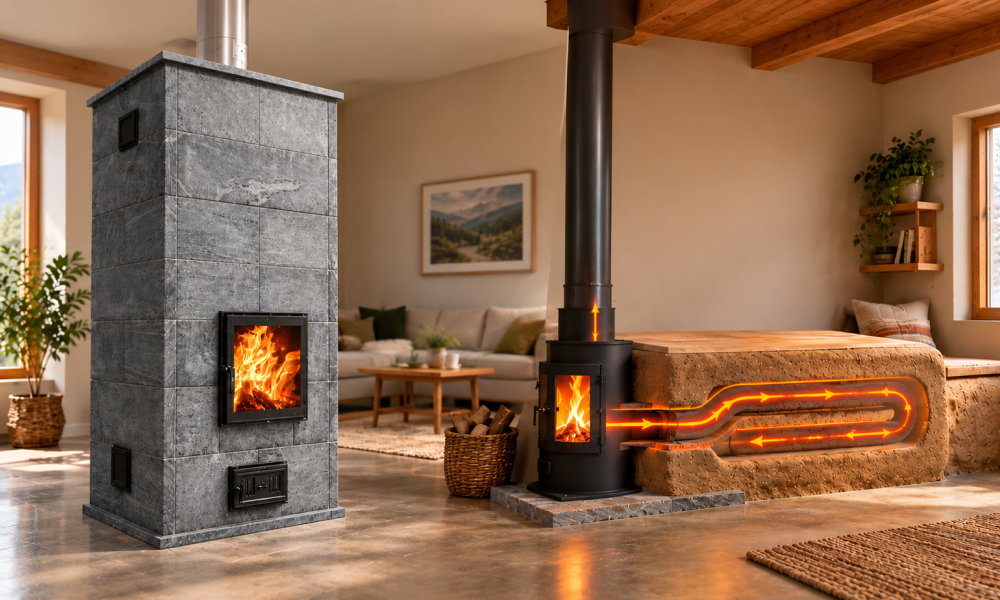
If you want wood heat that keeps working after the fire goes out, you’ll eventually land on the masonry heater vs rocket mass heater question. Both are thermal mass heating systems.
Both burn wood hot, push the exhaust through a dense mass of stone, brick, or cob, and let that mass radiate warmth long after the flames are gone. They look different, they cost very different amounts to build, and the paperwork around them isn’t the same.
Homeowners tend to compare them on four things: how efficiently they burn wood, how long they hold heat, what installation involves, and what it all costs. We’ll take those one at a time.
One disclosure first. Greenstone builds masonry heaters, so we have a stake in this. We’ve tried to be fair anyway, and where a rocket mass heater is the better fit for someone, we’ll say so.
What Is a Masonry Heater?
A masonry heater is a wood-burning heater built around a firebox, a set of internal gas passages, and a large body of heat-storing masonry. If you want the full primer, our guide to what a masonry heater is covers it from the ground up. Here’s the short version.
How a Masonry Heater Works
You load the firebox with a measure of dry wood and let it burn fast and hot. Because the fire gets plenty of air and burns at high temperature, it consumes most of the fuel and much of the smoke along with it. The hot gases then travel through channels built into the masonry, winding back and forth, and hand their heat to the mass around them. By the time the exhaust leaves through the chimney, a lot of that heat has been left behind.
How Masonry Heaters Store and Release Radiant Heat
That mass is the whole point. Dense stone, brick, or soapstone soaks up heat quickly and gives it back slowly, so the surfaces of the heater keep radiating warmth for hours after the fire has burned out. This is masonry heater heat retention at work, and it’s why people describe the heat as steady and gentle rather than hot-then-cold. Radiant heat warms people, furniture, and walls directly, which is a different feeling from a blast of warm air.
How long it lasts depends on the size of the heater, the materials, and how the house holds heat, but a well-matched unit commonly keeps a home comfortable for many hours between firings.
Common Masonry Heater Designs and Materials
There are several different types of masonry heaters, including contraflow, bell-style, and tile-clad Kachelofen designs, and modern builders have updated them for contemporary interiors. Materials vary too.
Brick is the traditional choice, and tile adds color and pattern. Soapstone is popular because it stores a lot of heat and finishes beautifully, which is why it’s the stone we build with. Some heaters add a bench, a cooktop, or a wood-fired bake oven built into the same structure.
What Is a Rocket Mass Heater?
A rocket mass heater grew out of the rocket stove, a small, hot-burning stove designed to get the most heat from small-diameter wood. Wikipedia has a general overview of the idea. Builders took that efficient burn and connected it to a large thermal mass, usually a bench or wall, so the heat gets stored instead of vented.
How a Rocket Mass Heater Works
Most designs start with a feed tube, where you load sticks of wood, leading into a horizontal burn tunnel. From there the hot gases rush up through an insulated riser, where the burn is meant to be very hot and nearly complete.
Then the exhaust is pushed through a long path, often a duct buried in a bench, before it finally exits through a chimney. The exact layout varies a lot from build to build, and that matters, because the proportions of each part affect how well the heater draws and burns. Two heaters that look similar can perform very differently.
How Rocket Mass Heaters Store Heat in a Thermal Mass
The exhaust path is what feeds the mass. As the hot gases travel through the duct inside a dense material, such as cob, brick, or stone, they give up most of their heat, and the mass then releases it slowly into the room.
This is rocket mass heater heat retention, and it’s the same basic principle as a masonry heater. The amount of mass, the length of the exhaust path, and the materials all shape how much heat is stored and for how long.
Common Rocket Mass Heater Designs and Construction
Many rocket mass heaters are one-off, owner-built projects, and a lot of builders share designs and lessons online. The usual result is a heated bench or a wall of cob or masonry with a small stove on one end.
There are variations in rocket mass heater design, from compact benches to larger whole-room installations. Rocket mass heater construction is hands-on work, and builders often use salvaged materials, firebrick, and metal drums. Some manufactured rocket-style heater cores are also sold, which can be paired with a site-built mass.
Masonry Heater vs. Rocket Mass Heater: Key Differences
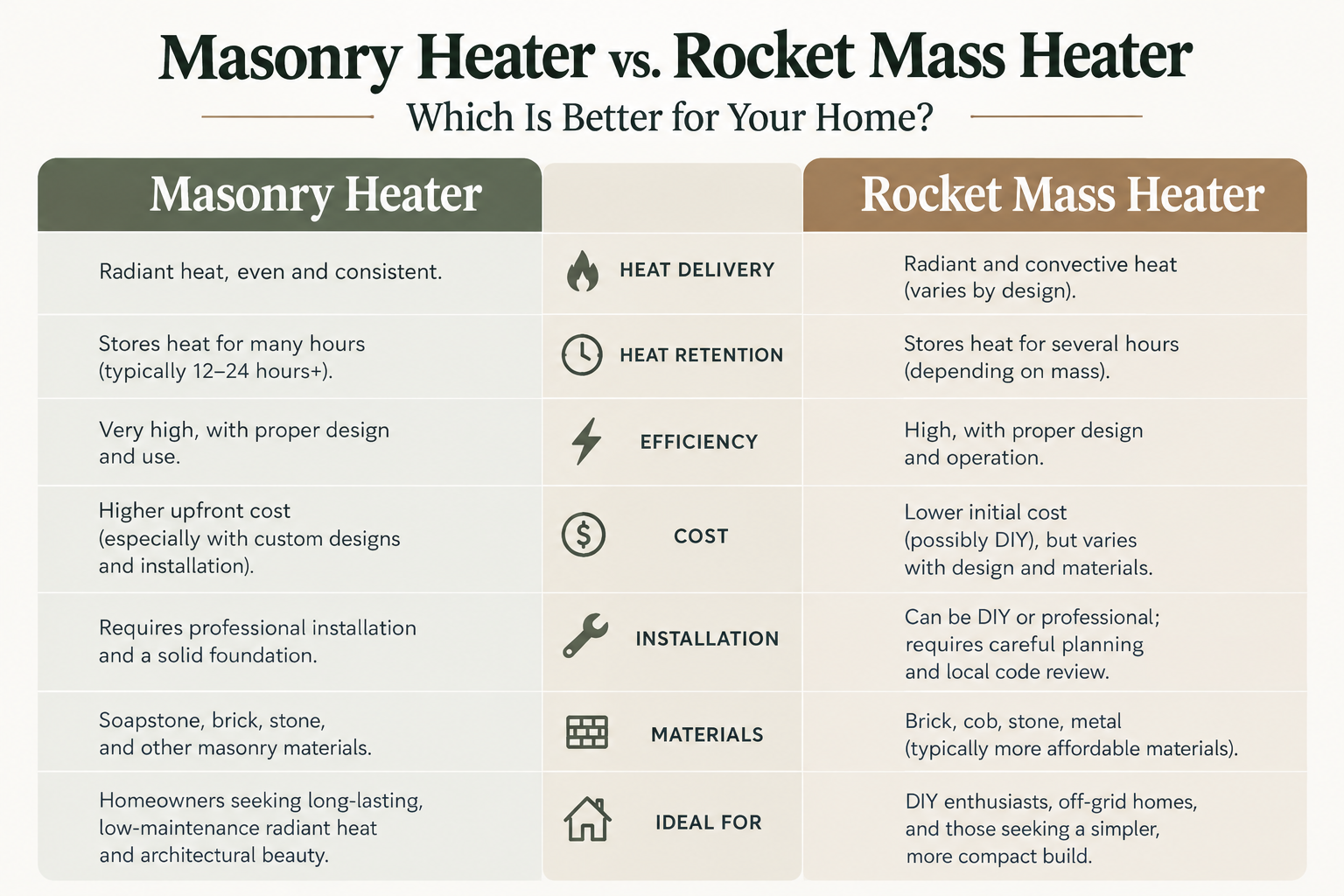
When people compare a rocket mass heater vs masonry heater, the difference is less about the idea and more about how each one gets built and approved. This table gives the broad picture, with the caveat that individual designs vary.
| Masonry heater | Rocket mass heater | |
| Combustion and heat transfer | Large firebox burns a batch of wood hot, then gases travel through engineered channels in the mass | Small, insulated burn chamber and riser, then a long exhaust path through the mass |
| Thermal mass and heat distribution | Large, central mass radiating from its surfaces | Mass usually a bench or wall, with heat spread along the exhaust path |
| Typical design and appearance | Finished, furniture-like, often in soapstone, brick, or tile | Often a cob or masonry bench, with a more handmade look |
| Installation and construction | Usually built by trained professionals, sometimes from prefabricated components | Often owner-built, though some are professionally built |
| Maintenance and operation | A hot fire loaded once or twice a day, with occasional cleaning and inspection | Small, frequent loads of wood, plus cleaning of the exhaust path |
| Suitability for different homes | Fits permanent, architecturally integrated installations | Fits owner-builders and custom projects where local rules allow it |
Neither column wins every row. A masonry heater tends to come out ahead where you want a finished, professionally designed feature with a clear approval path. A rocket mass heater tends to come out ahead where a hands-on build and a low materials budget matter most.
Masonry Heater Efficiency vs. Rocket Mass Heater Efficiency
Combustion Efficiency and Wood Consumption
Two ideas get mixed up here, so it helps to separate them. Combustion efficiency is about how completely the fire burns the wood.
Overall heating performance is about how much of that heat actually ends up warming your home, and how long it stays there. A system can burn well and still lose heat up the chimney, or burn merely okay and capture heat very well.
For both heaters, a few things matter more than the label. Dry firewood matters. Operating the heater the way it was designed matters. And the quality of the design matters a great deal, which is a bigger deal for rocket mass heaters, since so many are one-off builds.
On the masonry heater side, there’s testing to point to. One field study from the University of Oregon measured a contraflow masonry heater in a real home at about 90 percent efficiency, which is one data point, not a promise for every heater.
Our deeper look at masonry heater efficiency unpacks the combustion side in more detail. On the rocket mass heater side, advocates report very high efficiency and large wood savings, and many owners are clearly happy with their heaters.
But we’re not aware of broad, independent test data comparable to what exists for masonry heaters, and several sources note that testing standards for rocket mass heaters are still developing.
So we’d treat the strongest efficiency claims on either side with some care. As for wood fuel consumption, both can use less wood than a conventional stove for the same comfort, but we wouldn’t claim a firm winner.
Heat Retention and Long-Lasting Radiant Heat
Both systems store heat in mass and release it as radiant warmth, so it’s tempting to ask which holds heat longer. The honest answer is that it depends. The amount and type of mass, the materials, how the heat gets into that mass, and how the heater is fired all matter, and a large, well-designed rocket mass heater could outlast a small masonry heater, or the other way around. Anyone who tells you one always retains heat longer isn’t comparing specific units.
Heating Performance in Cold Climates
In a cold climate, the question shifts from “how does it burn” to “how much heat does my house actually need.” Insulation, floor plan, window quality, and sizing all decide whether a thermal mass heater can handle the load.
Wood-burning heating systems of both kinds work best in compact, well-insulated, reasonably open homes. Heating a home with wood through a long winter takes a heater matched to the space, which is why our masonry heater sizing guide starts with the home and not the heater.
Masonry Heater Cost vs. Rocket Mass Heater Cost
How Much Does a Masonry Heater Cost?
Several things drive masonry heater cost: the size of the heater, the materials (soapstone and natural stone cost more than plain brick), whether the design is custom, delivery, and professional installation.
Foundation work and chimney changes can add to the total. As a rough idea, a custom, professionally installed masonry heater often runs well into five figures, and prefabricated options tend to sit lower.
Masonry heater installation cost also depends on your house, so treat any single number carefully and ask for a written quote.
How Much Does a Rocket Mass Heater Cost to Build?
This one swings the most. Rocket mass heater cost depends heavily on whether you build it yourself. DIY guides commonly cite a few hundred dollars up to around a thousand for materials, depending on whether you use salvaged parts or buy firebrick and new metal.
A manufactured core can cost more than that on its own, and hiring a contractor to build a complete system can run into the thousands. Rocket mass heater DIY is cheap in dollars, but it costs time, planning, and a willingness to learn.
Long-Term Operating Costs and Value
Operating cost mostly comes down to firewood, maintenance, and how long the system lasts. A masonry heater has few moving parts and is built to last decades.
A well-built rocket mass heater can last a long time too, though the durability of a one-off build depends on its materials and workmanship.
We won’t hand you a savings figure, because how much wood you burn depends on your home, your climate, and your habits, and neither side has reliable head-to-head numbers.
The fairer way to look at value is upfront investment against how long the heater serves you and how much of your time it takes to run.
Installation Requirements for Masonry Heaters and Rocket Mass Heaters
Masonry Heater Installation and Foundation Requirements
A masonry heater is heavy, so the first questions are structural: what can the floor carry, does it need reinforcement, and where will the chimney run? Clearances to combustible materials and chimney design matter just as much.
This is why masonry heater installation is normally handled by experienced professionals. Our overview of professional masonry heater installation explains what that process looks like.
Rocket Mass Heater Installation and Building Codes
Rocket mass heaters have their own installation demands. A rocket mass heater is site-specific, so the exhaust routing, clearances, and the weight of the mass all need planning, and any permanent combustion appliance with a flue generally needs a permit.
Rocket mass heater building codes are where things get complicated, because horizontal exhaust runs and unconventional layouts aren’t compatible with every local code. Builders often work with local officials, and some bring in an engineer to document the design.
Are Rocket Mass Heaters and Masonry Heaters Legal in Residential Homes?
It depends on where you live. In the U.S., model building codes include provisions for masonry heaters, and ASTM E1602 is the standard guide for their construction, which gives builders and inspectors a common reference.
Rocket mass heaters, as far as we know, generally don’t have a dedicated code pathway, so acceptance varies by jurisdiction, and some insurers are cautious about them.
That doesn’t mean they’re illegal. It means you should confirm the rules with your local building department, and your insurance company, before you build. For masonry heaters, our overview of masonry heater code requirements is a good place to start.
Safety and Maintenance: Which Heating System Is Easier to Manage?
Wood-Burning Heater Safety Considerations
Any wood-burning appliance deserves respect. Safe firing practices, proper clearances to anything combustible, and a well-kept chimney matter for both heaters.
Carbon monoxide protection matters too. Working CO alarms belong in any home with a combustion appliance, and they’re more than a suggestion with a heater that’s built on site.
For rocket mass heater safety, the main concern is design and build quality. A poorly proportioned or badly assembled system can draw poorly and send smoke back into the room, which is a real carbon monoxide risk.
That’s not a reason to avoid rocket mass heaters. It’s a reason to follow proven designs closely, test carefully, and get the design checked. Masonry heater safety follows a similar logic, with the added comfort of a long-standing standard and professional installers behind the build.
Cleaning, Inspection, and Routine Maintenance
Both need ash removal, and both need regular inspection of the combustion area and the exhaust pathways, because soot can build up where gases cool. The routine depends on the design.
A masonry heater is usually fired once or twice a day with a bigger load and gets an annual chimney check. A rocket mass heater takes smaller, more frequent loads, and builders often include cleanouts so the exhaust duct can be reached.
If you choose a rocket mass heater, make sure the design lets you actually get in there and clean it.
Advantages and Disadvantages of Masonry Heaters vs. Rocket Mass Heaters
Masonry Heater Pros and Cons
Pros
- Radiant heat that stays steady for hours
- A finished, architectural look, with design flexibility
- A clear approval path in many places, since masonry heaters are recognized in model codes
- Optional extras such as a bake oven or a warm bench
Cons
- A bigger upfront investment than most alternatives
- Heavy, so the structure beneath it needs planning
- Installation by qualified professionals rather than as a DIY project
Rocket Mass Heater Pros and Cons
Pros
- Low materials cost if you build it yourself
- Good thermal storage, and a lot of room to customize the design
- Appeals to people who want to build their own heating system
Cons
- Quality depends heavily on the design and on whoever builds it
- Construction is complicated and unforgiving of mistakes
- Code approval and insurance can be uncertain
- Smaller loads of wood mean tending the fire more often
Neither list makes one heater universally better. They describe two different kinds of project.
Which Is Better for Your Home: A Masonry Heater or a Rocket Mass Heater?
When a Masonry Heater May Be the Better Choice
A masonry heater tends to suit people who want a professionally designed, permanent heating feature that becomes part of the house.
If you care about architectural integration, soapstone finishes, comfortable radiant warmth, and maybe a bake oven or cooktop built in, it’s hard to beat. It also fits if you want a clear approval path and a builder standing behind the work.
When a Rocket Mass Heater May Be Worth Considering
A rocket mass heater is worth a look if you’re drawn to a custom or DIY thermal mass project, you have the time and skill to do it carefully, the design is appropriate for your home, and local rules permit it. For the right owner-builder, it can be a rewarding project at a modest materials cost.
How to Choose the Right Thermal Mass Heating System
Start with the practical facts about your home: its size, heating demand, floor plan, and insulation. Then be honest about budget and construction type, whether it’s new or existing, and what your local codes allow.
Finally, check who can actually build it. Access to qualified installers is a bigger factor than most people expect. Talk to your building department early, and get any design reviewed by someone with real experience before you commit.
Frequently Asked Questions
Is a masonry heater more efficient than a rocket mass heater?
Not necessarily. Both can burn wood very cleanly, and both can capture a lot of heat. Masonry heaters have more established testing behind them, while rocket mass heater results vary by design and build. Efficiency depends on the specific heater, dry fuel, and how you operate it.
Which retains heat longer: a masonry heater or a rocket mass heater?
It depends on the individual heater. The amount of mass, the materials, the design, and how it’s fired all affect heat retention. A larger, well-built unit of either type can hold warmth for many hours, so there’s no rule that one always wins.
How much does a rocket mass heater cost to build?
Widely cited DIY estimates run from a few hundred dollars to around a thousand for materials, depending on salvaged versus new parts. Manufactured cores and professional builds can cost considerably more. Add your time and any permit or engineering costs to the picture.
Can a rocket mass heater heat an entire house?
Sometimes. They’re usually described as best suited to compact, well-insulated, open-plan homes. Whether one can carry a whole house depends on its size and design, your climate, and the layout. Rooms far from the heater may stay cooler.
Are rocket mass heaters legal in residential homes?
Often, but it varies. Many jurisdictions have no specific rules for them, so permits, inspections, and insurance acceptance depend on local officials. Check with your building department and your insurer before building, and consider having an engineer or experienced builder review the design.
Which heating system uses less firewood?
Both can use less wood than a conventional stove for the same comfort, but we don’t know of reliable head-to-head data. Your wood use will depend on the design, home insulation, climate, how dry the wood is, and how you fire the heater.
Can a masonry heater be installed in an existing home?
Often, yes. It depends on whether the floor can support the weight, where the chimney can go, how much space you have, and local requirements. A site assessment by a qualified installer is the best way to find out whether your house is a good candidate.
Ready to Find Out Whether a Masonry Heater Fits Your Home?
Both heaters rest on the same smart idea: burn wood hot, store the heat in mass, and let it out slowly. Which one is right comes down to your house, your budget, who’s building it, and what your local building department will approve.
If a professionally designed masonry heater sounds like the better fit, book a consultation with Greenstone Masonry Heaters. Tell us about your home, your climate, and how you want to heat it, and we’ll give you an honest read on size, design, and installation. And if it turns out a different approach suits you better, we’ll tell you that too.